
IRRIGATION / PRACTICAL GUIDES
Soaker Hose vs Drip Irrigation: How to Choose
By James Thompson
Some links in my articles are affiliate links. I may earn a commission when you buy through them.
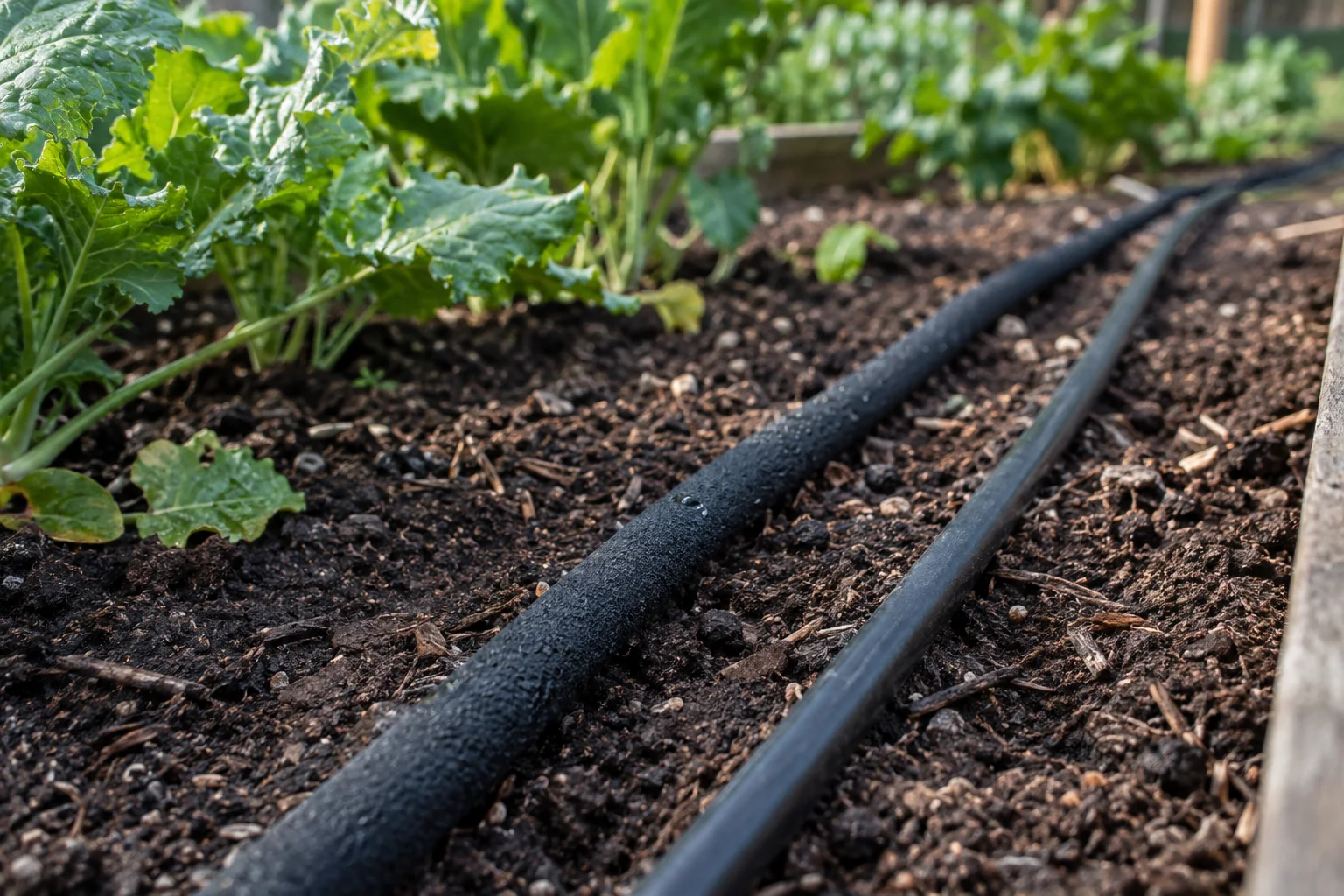
A soaker hose releases water along its porous length. A drip system delivers water through emitters positioned at selected points, or through a purpose-made dripline with built-in emitters. The useful choice depends on whether you need to water a continuous planted strip or individual locations.
The practical answer
Use a soaker hose for a continuous planted strip when its length and pressure requirements fit. Use a drip kit for separated pots or points where watering the gaps would waste water.
Useful product route: GARDENA 15 m soaker hose or Hozelock 20-pot drip-watering kit
Match the watering pattern to the planting
A closely planted border or hedge may suit a hose laid along the root area. Separate pots usually call for more targeted outlets: wetting the paving between them achieves little. A regular crop row can suit a dripline if its emitter spacing matches the intended layout.
Sketch the area, marking gaps as well as plants. Long unplanted stretches are a reason to consider plain supply tube between watering sections rather than a continuously porous hose.
Three different tubes that are easy to confuse
- Plain supply pipe: carries water to other components and should not release it along its length.
- Porous soaker hose: seeps through the hose wall.
- Dripline: contains watering outlets at defined intervals.
A retailer’s use of “irrigation hose” may describe any of these. Confirm what the product actually does before comparing prices. Our irrigation component guide shows the role of a plain supply line.
Where does water leave the tube?
Compare adjustment and maintenance
Individual emitters let you place watering points around changing containers or planting positions. They also create more connections to inspect. Soaker hose has fewer separate watering parts, but you still need to check how evenly the complete length wets the soil.
Look at accessibility as well as installation speed. Can you inspect the far end, clean the inlet equipment and remove the end fitting? Covering a system immediately can make early faults harder to find.
Pressure and length limits still apply
Neither option should be chosen solely from its advertised length. Follow the manufacturer’s pressure requirements and maximum connected runs. Hozelock advises pressure reduction for its porous soaker hose where supply pressure is high.
Adding a timer automates an unsuitable layout just as easily as a suitable one. Choose the water-delivery equipment first, then a watering timer that fits your supply and schedule.
Use a trial section to make the decision
Install a representative short section, run it under normal conditions and inspect the root-area moisture. Note whether water stays near the intended plants or pools in one spot. Check the beginning and end rather than judging only the nearest section.
For mixed planting, separate watering areas can be more practical than forcing every plant onto one routine. Our guide to irrigation zones explains how to organise that decision before extending the pipework.
What to verify before buying either option
- Porous soaker hose: obtain the exact model’s permitted supply pressure, maximum connected length, required inlet equipment and cleaning instructions. A roll length is not proof that several rolls can be joined. We have not verified a complete model-specific set of limits here, so no particular soaker is recommended.
- Drip irrigation: match the outlets and supply components to the planting layout. Our tubing and fittings buying guide helps turn a documented compatible system into a parts list.
For both options, trial a representative section before buying enough equipment for the whole garden.
Explore all irrigation guides →