
IRRIGATION / PRACTICAL GUIDES
Pressure Compensating vs Adjustable Drippers
By James Thompson
Some links in my articles are affiliate links. I may earn a commission when you buy through them.
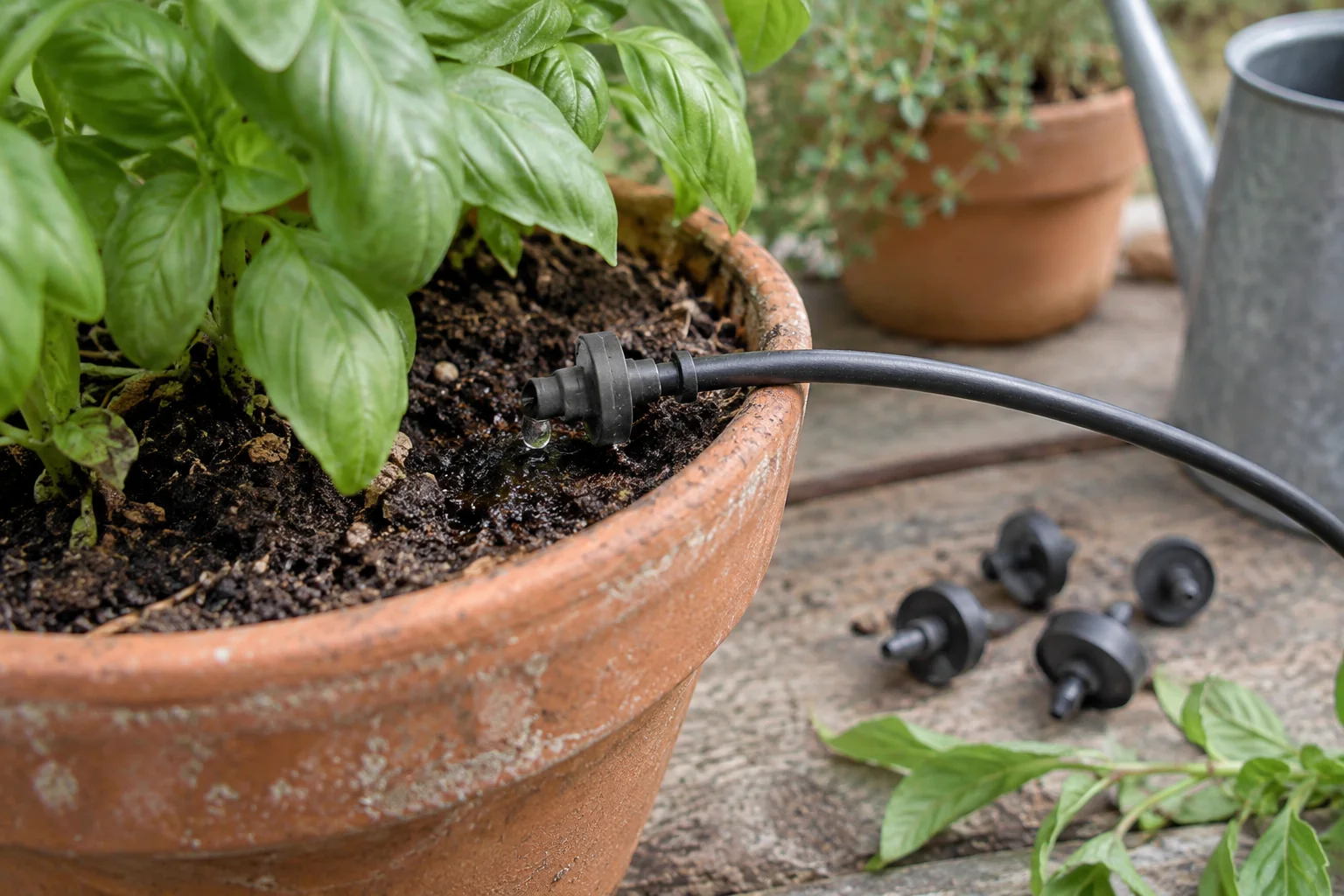
Pressure compensation and adjustability describe different features. One manages changes in supply pressure within a specified range; the other lets you change the watering output. Start with the plant layout and the equipment specification rather than treating either label as a universal upgrade.
The practical answer
Choose pressure-compensating drippers when the stated pressure range and layout make even delivery useful. Choose adjustable heads when individual plants need manual tuning and you can revisit those settings.
Useful product route: Hozelock pressure-compensating drippers or Hozelock 20-pot drip-watering kit
What pressure compensation does
A pressure-compensating emitter is designed to maintain its specified delivery across a stated operating-pressure range. It still needs sufficient pressure and a suitable supply. The label does not mean it will work at any pressure, overcome a blockage or make every layout deliver identical amounts of water.
For a specific example, Hozelock lists its Pinch Drip pressure-compensating dripper with a 4 litres-per-hour output and specified connections for its 4 mm and 13 mm tubing arrangements. Always check the exact model rather than transferring those specifications to another emitter.
What adjustable means
An adjustable watering point lets you change the output using its control. Check whether the product delivers drops, streams or a spray: similar-looking heads can water differently. Adjustment can be useful where individual containers need different amounts, but each setting needs checking after installation.
Do not assume an adjustable product is also pressure compensating. Look for both features explicitly in the specification if you need them. Our component guide places emitters within the wider system.
Pressure compensation
Manages changes in supply pressure within the stated operating range.
Check: rated flow and pressure limits.Adjustable output
Lets you change output using the product control.
Check: output range and watering pattern.Compare the specifications that matter
- Flow: the rated output or adjustment range, and the pressure at which it applies.
- Operating range: minimum and maximum pressure requirements.
- Installation: end-of-line, in-line or directly mounted to supply pipe.
- Water quality: required filtration and the recommended cleaning method.
- Connections: compatible tube and fittings for the exact range.
Translate output into a starting check
For a nominal 4 litres-per-hour emitter, 15 minutes corresponds to one litre if it is delivering at its stated rate. That arithmetic is a way to understand the rating, not a recommended watering schedule. Container size, growing medium, weather and the plant’s needs determine the appropriate amount.
Test the installed system with suitable containers or observation of the watering points, then inspect moisture in the growing medium. Recheck after adjusting heads or adding branches.
Make the choice from your layout
Group similar watering needs where possible. Compare manufacturer limits for pipe lengths and emitter counts, and keep a record of your settings. For a new project, use our greenhouse planning guide; for water-quality requirements, read our filtration guide.
Product examples on Amazon
Compare these examples with your chosen manufacturer’s specifications before ordering. These are individual product examples, not a confirmed compatible bundle.
Hozelock in-line pressure-compensating drippers — view on Amazon
Check the connection size, rated flow and permitted pressure for your system.Hozelock 20-pot drip watering kit — view on Amazon
Compare the kit contents and controller with your layout before adding separate parts.
Explore all irrigation guides →
Sources
Choose compatible emitters.
Compare fixed, adjustable and pressure-compensating drippers before buying →