
IRRIGATION / PRACTICAL GUIDES
How to Calculate Drip Irrigation Water Use
By James Thompson
Some links in my articles are affiliate links. I may earn a commission when you buy through them.
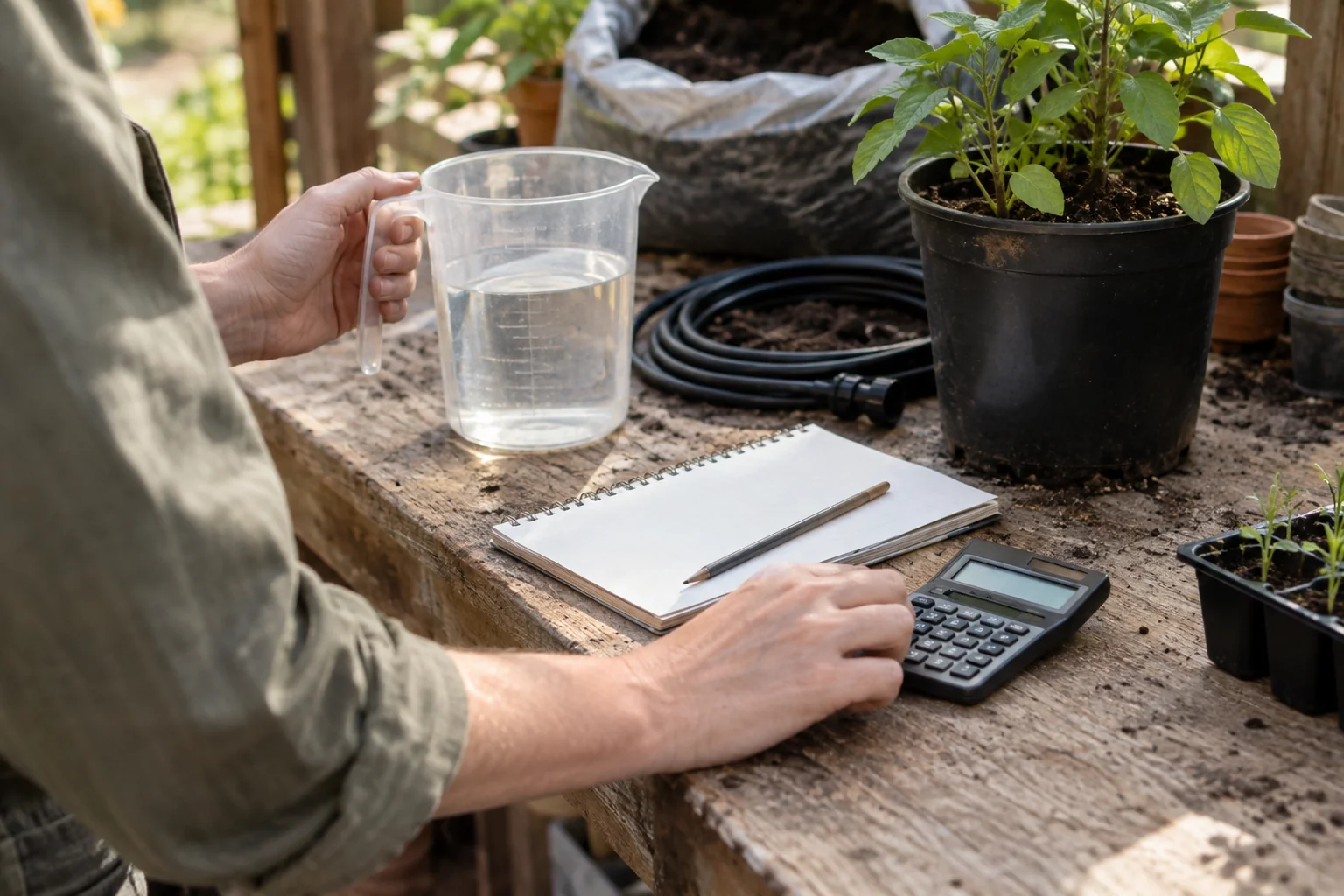
To estimate drip irrigation water use, multiply each emitter’s hourly flow by its runtime in hours, then add the outputs together. This gives a planning estimate. The actual delivery still needs checking because pressure, adjustment and obstructions can change what reaches each plant.
The practical answer
Multiply each emitter’s litres-per-hour rating by runtime in hours, then add the active emitters. Use a catch test to check the estimate before sizing a reservoir or schedule.
Useful product route: Hozelock pressure-compensating drippers or Hozelock Sensor Controller Plus
The basic calculation
Water per emitter in litres = flow in litres per hour × runtime in minutes ÷ 60.
For an emitter rated at 4 litres per hour, a 15-minute run gives an estimated 1 litre. Ten such emitters running together for 15 minutes give an estimated 10 litres in total. If that happens twice daily, the estimate becomes 20 litres per day.
These figures illustrate the arithmetic; they are not a recommended watering schedule or pot requirement. Hozelock lists 4-litre-per-hour products in its dripper comparison, but the flow specification applies at stated operating conditions.
Mixed flow rates need separate lines in your calculation
Imagine six 2-litre-per-hour emitters and four 4-litre-per-hour emitters. Their combined rated flow is 28 litres per hour: 6 × 2, plus 4 × 4. At a 20-minute runtime, estimated use is 28 × 20 ÷ 60, or about 9.3 litres.
For adjustable emitters, the maximum label value is not necessarily the current setting. Measure their output or use an established setting from the product instructions. Our dripper comparison explains why the features should be considered separately.
Worked example: add the groups first
6 × 2 L/h = 12 L/h
4 × 4 L/h = 16 L/h
Check the estimate with a collection test
- Run the system under normal operating conditions.
- Collect water from representative outlets for the same timed period.
- Measure the collected volume.
- Convert it to hourly flow: litres collected × 60 ÷ minutes tested.
- Compare near and distant outlets before changing the schedule.
For example, 300 millilitres collected over six minutes is equivalent to 3 litres per hour. A measured result below the label value can reflect operating conditions as well as a fault; investigate before assuming the emitter needs replacing.
Follow the detailed catch-test guide →
Estimate reservoir duration
Days of supply = usable stored litres ÷ estimated daily litres. A usable 120 litres at 20 litres per day gives six days mathematically. Allow a reserve and test the system at a lower water level. The container’s advertised capacity may include water below the intake.
See water-butt irrigation options before choosing a reservoir arrangement.
For the fixed daily doses on an indoor GARDENA 1265/1266 kit, use the model-specific reservoir calculation and siphon checks.
Water volume is not the same as plant need
The calculation describes delivery. It does not decide whether a plant needs that volume, whether the growing medium absorbs it evenly or whether water runs out too quickly. Observe the pots or bed after a trial cycle and adjust accordingly.
Keep a simple record of emitter count, flow, duration and daily cycles. Recalculate after adding outlets, and check system capacity when planning zones. This is more useful than increasing every runtime whenever one plant looks dry.
Product examples on Amazon
Compare these examples with your chosen manufacturer’s specifications before ordering. These are individual product examples, not a confirmed compatible bundle.
Hozelock in-line pressure-compensating drippers — view on Amazon
Check the connection size, flow and operating pressure.Hozelock Sensor Controller Plus — view on Amazon
Check the tap connection and whether light-based control suits your location.
Explore all irrigation guides →