
IRRIGATION / PRACTICAL GUIDES
Do You Need a Filter for Drip Irrigation?
By James Thompson
Some links in my articles are affiliate links. I may earn a commission when you buy through them.
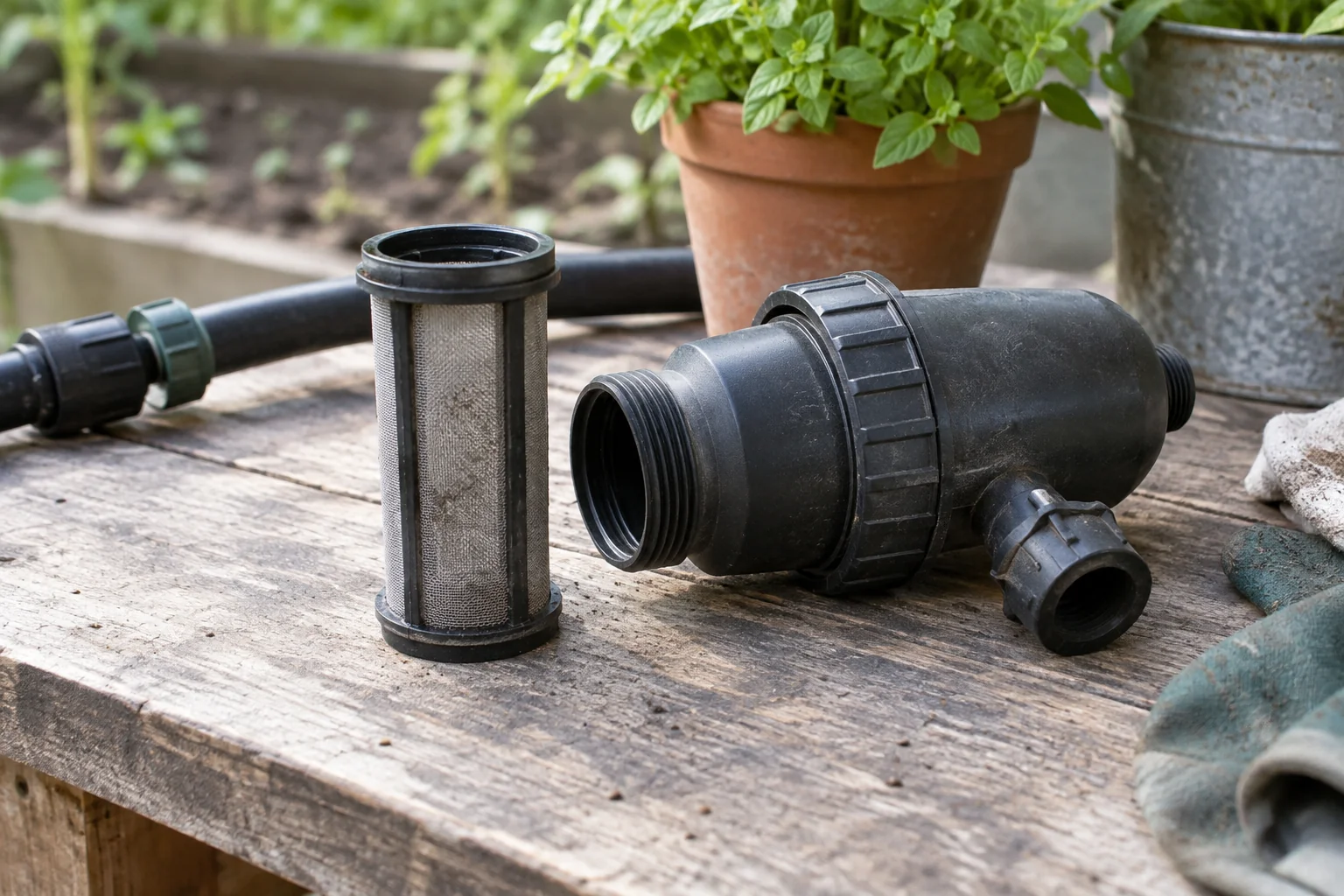
Check the filtration requirements before building a drip system. Small watering outlets can be affected by debris, and an emitter’s internal filter does not automatically replace the filtration specified for the complete system.
The practical answer
Use the filtration level specified for the emitters and water source. If a compatible inlet unit combines filtering and pressure reduction, check both ratings; one function does not imply the other.
Useful product route: GARDENA Master Unit 1000 listings
Start with the manufacturer’s requirements
Identify the emitter range and read its requirements for water quality and filtration. If a filter rating is specified, use that requirement rather than choosing a generic mesh size from another system. Check both the filter’s suitability and its permitted flow and pressure.
Ask whether filtration is already included in the inlet unit or kit. For example, GARDENA describes the Master Unit 1000 as incorporating a removable filter alongside pressure reduction for its Micro-Drip-System. That is a feature of this product, not proof that every regulator also filters water.
A filter and a regulator do different jobs
A filter removes particles within its design limits. A regulator manages pressure within its own operating limits. Neither is a substitute for the other. Choosing the correct filter will not fix excessive pressure, and fitting a regulator will not remove debris unless it also incorporates filtration.
Use the drip-system component guide to identify each part of the inlet arrangement. Follow the required installation order and direction shown in the instructions.
Two jobs at the inlet
Check filtration rating, flow and water-source suitability.
Check inlet and outlet pressure requirements.
Consider the water source
Record whether your supply is a tap, tank or pumped arrangement. Describe any visible sediment when checking suitability with the equipment supplier. A tank setup also needs sufficient pressure and compatible inlet equipment; a filter alone does not make a tap-fed kit suitable for gravity use.
Do not assume clear-looking water needs no filtration. Equally, do not assume one small filter can handle every water source. If the manufacturer does not specify suitability for your source, ask before buying.
Make cleaning practical
- Choose an installation position that leaves the filter accessible.
- Record the manufacturer’s inspection and cleaning instructions.
- Shut off the supply and release pressure before opening the equipment.
- Inspect and clean using the stated method; avoid improvised chemical treatments.
- Refit the filter and seals correctly, then check the system for leaks and delivery.
Follow the prescribed maintenance interval and inspect when delivery changes. A reduced flow can have other causes too, including a closed valve, kinked tube or unsuitable supply. Do not immediately replace all the emitters.
Before you order
Write down the required filtration specification, connections, operating limits and any kit parts already included. Read our dripper comparison alongside those details. Where an Amazon kit listing does not state its filtration provisions clearly, confirm the contents and manufacturer’s requirements first.
Product examples on Amazon
Compare these examples with your chosen manufacturer’s specifications before ordering. These are individual product examples, not a confirmed compatible bundle.
Hozelock 20-pot drip watering kit — view on Amazon
Compare the kit contents and controller with your layout before adding separate parts.Hozelock in-line pressure-compensating drippers — view on Amazon
Check the connection size, rated flow and permitted pressure for your system.
Explore all irrigation guides →
Sources
Choose inlet equipment.
Compare combined and separate filters and pressure regulators →