
Wall-Mounted Hose Reel or Hose Cart? Choose the Right Storage Setup
Some links in my articles are affiliate links. I may earn a commission when you buy through them.
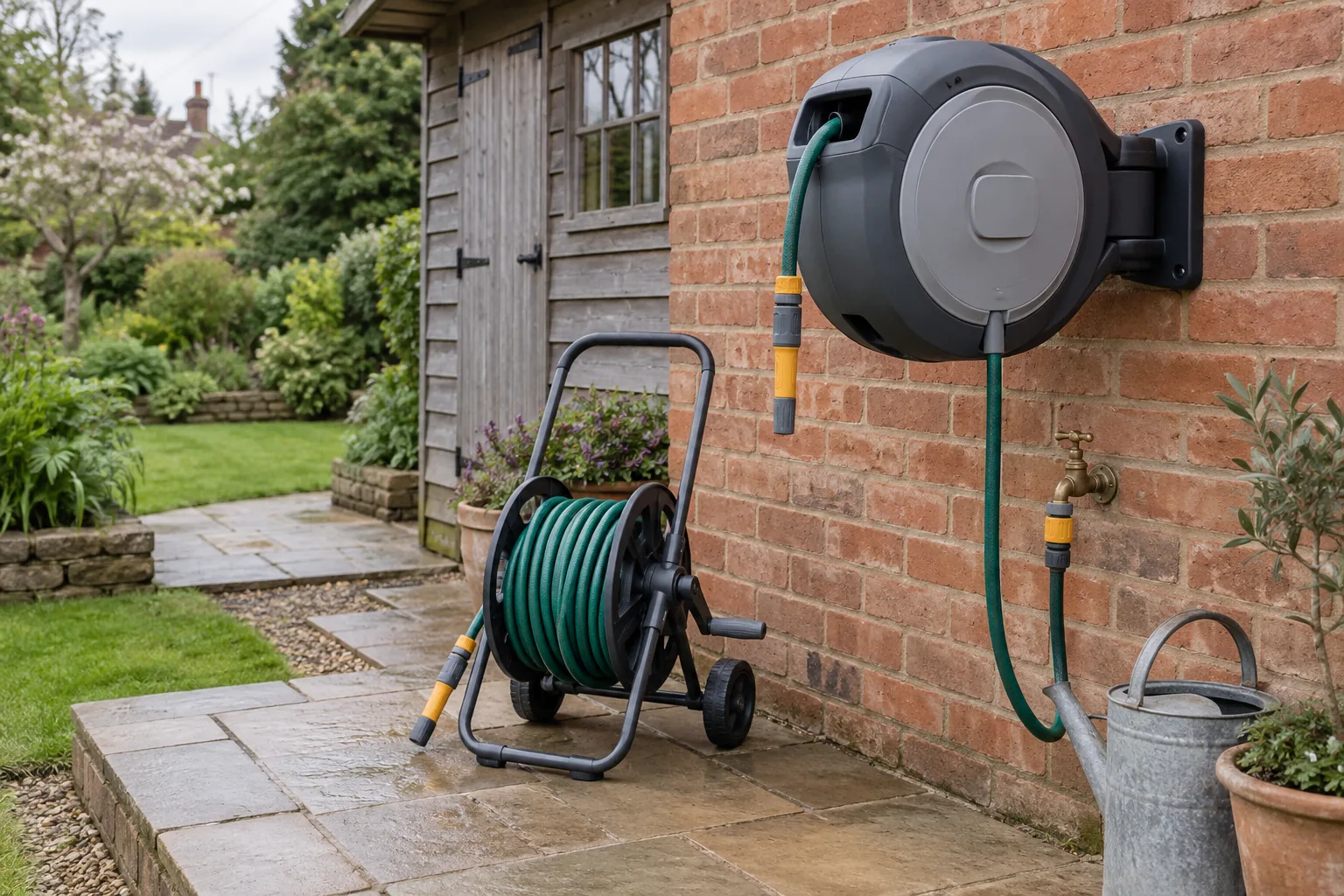
A wall-mounted automatic reel makes repeated watering quicker, but it commits the hose to one sound mounting point. A wheeled cart uses floor space and needs manual rewinding, yet it can follow the tap, move between areas and go into storage. Map the route, wall and storage journey before choosing the mechanism.
Fixed and automatic
Hozelock Auto Reel 20 m, SKU 2401: an enclosed, wall-mounted system with automatic rewind, automatic layering and a bracket that pivots through 180 degrees. Check the 20 m Auto Reel on Amazon UK.
Movable and manual
Hozelock 60 m Assembled Hose Cart with 30 m hose, SKU 2434: a wheeled open cart with manual rewind, adjustable towing handle, hose and fittings. Check the 30 m hose-cart set on Amazon UK.
These products are reference examples for the two formats. Start with the site constraints below, then confirm the exact SKU, hose length, included fittings and installation instructions on the current listing before ordering.
The quick decision
| Situation | Better starting point | Why |
|---|---|---|
| One tap serves most of a compact or medium garden | Wall-mounted auto reel | A fixed base and automatic return remove repeated carrying and hand winding. |
| No suitable solid wall near the useful tap | Wheeled cart | It avoids creating a questionable fixing point or placing the reel where the route begins badly. |
| Two taps or separated front and rear areas | Wheeled cart | The unit can move between connection points if its storage route is practical. |
| Hose used briefly but often | Wall-mounted auto reel | Automatic layering and rewind reduce the work at the end of every short use. |
| Cart travels between storage and tap after each use | Wheeled cart | A retractable towing handle and wheels suit a planned doorway-to-tap journey. |
| Limited floor space but a sound accessible wall | Wall-mounted auto reel | The enclosed reel folds towards the wall, though its operating sweep must remain clear. |
Verify the two formats, not just the hose length
Hozelock’s current Auto Reel product page lists the 20 m version as SKU 2401 and the 30 m version as SKU 2403. Both are enclosed wall-mounted reels with automatic rewind and hose layering. The bracket pivots 180 degrees, the kit includes hose and fittings, and the case includes accessory storage. The manufacturer also describes a controlled braking mechanism, a hose stop and an integrated child lock.
The Assembled Hose Cart product page lists a 60 m reel capacity. SKU 2434 includes 30 m of 12.5 mm hose; SKU 2435 includes 50 m. The cart uses easy manual rewind, has an adjustable-height towing handle and arrives assembled with fittings. Hozelock describes its wider stance and lower centre of gravity as stability features.
| Check | Auto Reel 2401 | Assembled Hose Cart 2434 |
|---|---|---|
| Storage format | Enclosed wall-mounted reel | Open wheeled cart |
| Included hose | 20 m | 30 m of 12.5 mm hose |
| Rewind | Automatic with automatic layering | Manual winding handle |
| Movement | Bracket pivots 180 degrees; fixed to one wall position | Wheels and adjustable towing handle |
| Assembly | Reel assembled; wall installation required | Assembled cart |
| Accessory storage | Yes | Yes |
| Registered guarantee stated by manufacturer | 5 years | 5 years |
Map the fixed reel as a triangle
A wall reel only works if three points agree: the tap, the mounting position and the furthest watering point. First measure the tap-to-bracket connection route. Then measure from the proposed bracket to the furthest point along the path the hose must actually follow. Add the distance needed to move around furniture, borders and corners; a straight line through a hedge is not usable reach.
Finally, check the return route. The hose should approach the reel without scraping repeatedly across a sharp corner, and the casing needs room to pivot without striking a gate, downpipe or opening door. The wall must be suitable for the load and fixings specified in the installation instructions. If you cannot confidently identify a sound mounting structure, choose a freestanding format or obtain appropriate installation advice.
Conceptual plan: use the selected product’s installation drawing and permitted mounting method.
Plan a cart as a transport route
A cart replaces wall fixing with movement. Measure the narrowest gate, doorway and gap on the path between storage and tap. Look for steps, deep gravel, soft ground and tight turns. Wheels that cross a smooth patio easily may be awkward on the route you actually have. Check that the handle height suits the person who will move it and that the stored cart can stand without blocking access.
Decide whether the hose normally stays connected to one tap or travels between taps. Repeated connection changes make compatible, sound fittings more important; our hose-connector guide separates hose bore from tap thread. If the cart moves between a front and rear tap, label any tap adapters that differ so the connection is deliberate rather than forced.
Put a value on rewind effort
Automatic rewind matters most when watering is frequent. Time one ordinary manual pack-away rather than guessing. If winding and guiding the hose takes 50 seconds and the hose is used 90 times in a season, that is 75 minutes of rewinding: 50 × 90 ÷ 60. The number is not a performance claim; it is a way to value convenience using your own routine.
Compare the whole routine, not winding time alone. For the cart, include wheeling it from storage, connecting it, hand winding and putting it away. For the fixed reel, include pulling the hose along its actual route and guiding it back as instructed. A fixed system may save winding but create an awkward long route; a cart may take longer to wind but start closer to the work. Use your own timings for both routines.
Separate length from storage choice
Do not buy 30 m simply because the mobile example includes it. Measure the route and allow a modest practical margin without leaving a large coil permanently full of water. Longer hose adds weight to move and more material to rewind. Our 20 m versus 30 m hose-reel guide gives a step-by-step route method.
Hose length also does not guarantee flow. Bends, connectors, bore and the outlet tool all contribute resistance. If the final task is gentle plant watering, choose the storage system first, then match the end tool using the spray-gun versus watering-lance guide. Where several branches share the tap, the tap-distributor guide explains how to measure combined demand.
Installation and ownership checklist
- Draw the route. Record tap-to-storage, storage-to-furthest-point and the real path around obstacles.
- Inspect the wall or transport path. A fixed reel needs a suitable structure and clear pivot area; a cart needs passable ground, openings and indoor floor space.
- Confirm the exact SKU. Similar product names can cover several hose lengths. Match the model number and included hose on the manufacturer page and retailer listing.
- Check fittings before use. Confirm the tap connector, feeder arrangement and hose-end accessories suit the existing outlet.
- Follow the operating sequence. Use the manufacturer’s instructions for locking, rewinding and wall installation. Do not improvise fixings from appearance alone.
- Plan winter storage separately from daily use. Follow the exact model’s draining, frost-protection and storage instructions. A wall-mounted format does not mean the reel should stay outdoors all winter. Check its removal and storage procedure before purchase; a cart’s wheels help with transport, but do not replace winter-care instructions.
- Keep the hose clean while returning it. Remove grit and avoid guiding a muddy or damaged section into an enclosure where inspection becomes harder.
The buying decision
Choose the 20 m Hozelock Auto Reel when one suitable wall position covers the route and automatic pack-away will save effort often. Choose the Hozelock 2434 cart with 30 m hose when regular movement between taps or between storage and the tap matters more than automatic rewind. If neither route works cleanly, change the storage plan before buying more hose.