
Spray Gun or Watering Lance? Choose Reach, Spray and Trigger Control
Some links in my articles are affiliate links. I may earn a commission when you buy through them.
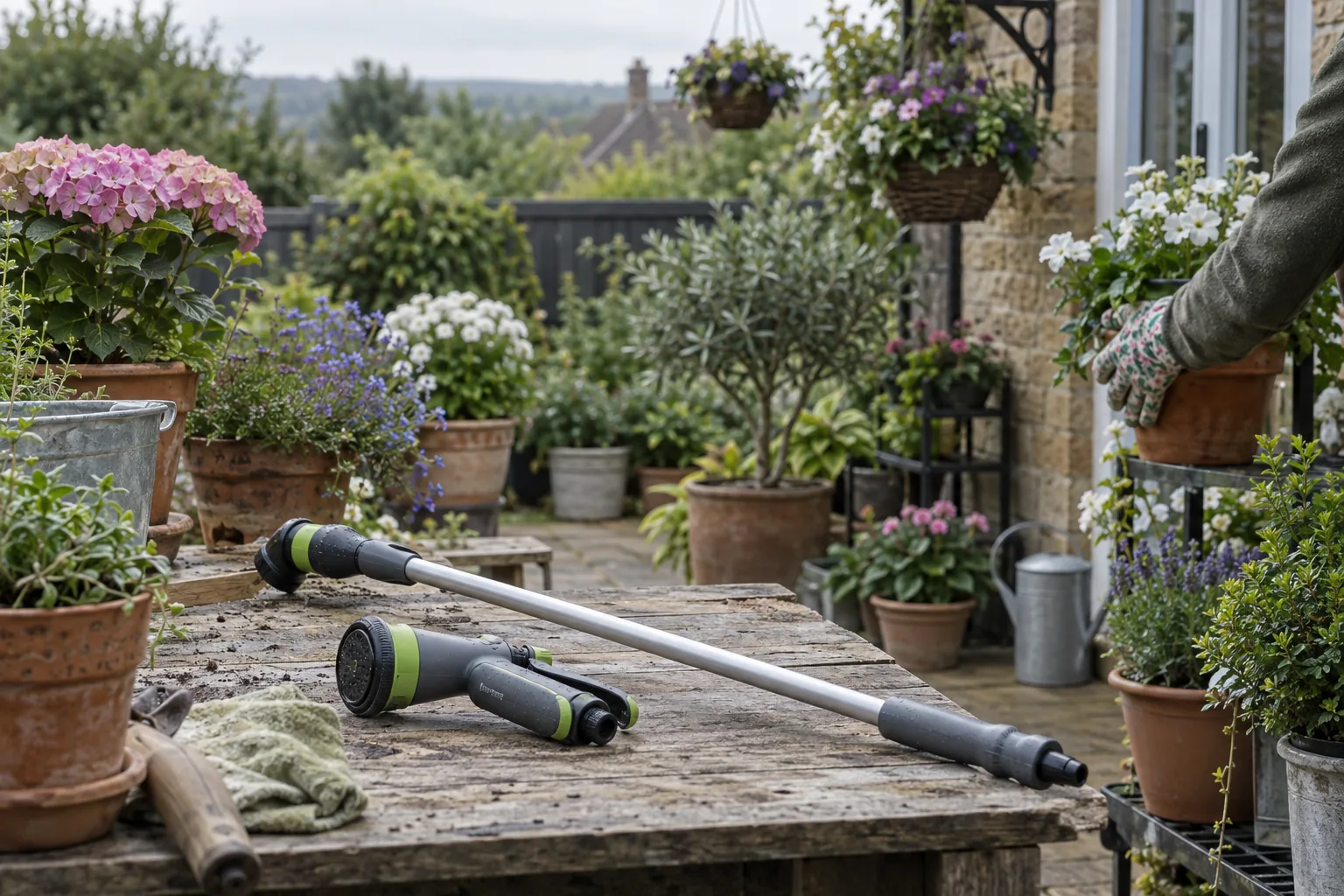
A short spray gun suits plants you can comfortably stand beside. A watering lance earns its length when pots sit overhead, behind borders or beneath dense foliage. Choose from the route you actually water, then check spray pattern, flow control and the trigger before comparing extras.
Choose compact control
GARDENA Classic Watering Sprayer 18365-20: one soft spray pattern, adjustable water quantity and a lockable trigger for pots and nearby beds. Check the Classic Watering Sprayer on Amazon UK.
Choose extra reach
GARDENA Comfort Hanging Basket Lance 18335-20: a 90 cm shaft with soft-spray and bubble-jet patterns for high or awkward containers. Check the 90 cm lance on Amazon UK.
These are clear examples of the two formats, not claims that one brand suits every hose system. The right answer may be both: a compact sprayer for routine beds and a lance for the few containers that otherwise require stretching or climbing.
The quick decision
| Your repeated task | Better starting point | Reason |
|---|---|---|
| Pots and beds below waist height | Compact spray gun | Less length to carry, turn and store. |
| Hanging baskets above shoulder height | Watering lance | Moves the outlet towards the compost without raising the hose or arm as far. |
| Deep borders viewed from a path | Watering lance | Reaches past foliage so water can be aimed nearer the root area. |
| Mixed patio containers and occasional cleaning | Check patterns carefully | A soft plant spray is different from a concentrated cleaning jet; neither example here is sold as a multi-pattern cleaning gun. |
| Very small storage space | Compact spray gun | A 90 cm tool needs a safe hanging or wall position. |
Compare the two reference products accurately
GARDENA describes the Classic Watering Sprayer 18365-20 as a soft-spray tool for potted plants and areas. Its on/off trigger locks for continuous flow and its water quantity is adjustable. The Comfort Hanging Basket Lance 18335-20 is 90 cm long, regulates water quantity and offers soft-spray and bubble-jet patterns. Its pulse trigger can also be locked.
| Feature | Classic Watering Sprayer 18365-20 | Comfort Lance 18335-20 |
|---|---|---|
| Reach | Compact hand tool; no extended shaft stated | 90 cm overall length |
| Stated use | Potted plants and areas | Hanging baskets or potted plants from a distance |
| Spray patterns | Soft spray | Soft spray and bubble jet |
| Water quantity regulation | Yes | Yes |
| Continuous watering | Lockable trigger | Lockable pulse trigger |
| Frost protection | Yes | Yes |
Measure reach as a route, not a straight line
Stand where the hose can move without crushing plants. From that position, estimate the distance from your hand to the compost surface of the furthest pot. Include the height above your shoulder and any railing, shrub or furniture the tool must pass. A 90 cm lance does not create 90 cm of useful horizontal reach in every position, but it can move the outlet far enough to keep your wrist and shoulder in a more neutral position.
For a hanging basket, aim to place water on the compost rather than spraying blooms and leaves from below. For a deep border, length is useful only if the head can be guided between foliage without snapping stems. If most of the route is within easy arm’s reach, the extra shaft can become something to catch on furniture.
The diagram is a planning aid. Check the actual tool dimensions, connector system and working space.
Spray pattern changes how water reaches the pot
A soft spray spreads water over a wider area, which helps reduce surface disturbance in pots and seedling trays. A bubble jet concentrates a gentler aerated flow at one point, useful when the outlet can be brought close to a container without splashing surrounding foliage. Neither pattern compensates for watering too quickly: dry compost may initially shed water down a gap at the pot edge.
Use a short first pass, wait for absorption, then return. Stop when water begins to drain freely rather than treating a fixed number of seconds as correct for every pot. Pot size, compost, root density, wind and recent rain all change demand. Our hanging-basket drip guide explains when repeated manual watering is a sign that a fixed line and emitters would be more suitable.
Trigger lock and flow control are separate checks
A trigger lock reduces the need to keep squeezing during a long round. Flow regulation lets you turn the outlet down for a small pot. Test the controls with the hand you normally use: a feature is only useful if you can set it without twisting your grip. Before disconnecting any hose-end tool, close the tap and release the pressure at the trigger.
Flow at the nozzle also depends on the hose length, bore, tap and fittings. If performance feels weak, inspect the whole route before blaming the spray head. A kink, partly closed connector or long narrow hose can matter more than the number of spray patterns. The hose connector size guide covers the bore and thread measurements that prevent mismatched fittings; the 20 m versus 30 m hose-reel guide shows how to measure a route without buying avoidable length.
Six checks before ordering
- Walk the watering route. Mark every pot that forces you to stretch, step into a border or lift the hose overhead.
- Choose the pattern for plants. Confirm the exact listing includes the soft or bubble flow you need; do not infer a cleaning jet from a generic “sprayer” label.
- Check the connector. Match the tool inlet to the hose-end connector already fitted, or budget for the correct compatible fitting.
- Try the grip logic. Look for accessible flow regulation and a lock you can intentionally engage and release.
- Plan storage. Let the tool drain, then store it where the trigger and head will not be knocked. The lance needs 90 cm of protected space.
- Protect from winter weather. A frost-protection claim is not a reason to leave water trapped in a tool outdoors. Disconnect, drain and store it according to the instructions.
The buying decision
If almost everything is reachable from the path, compare the compact Classic Watering Sprayer and keep the route simple. If high baskets or deep borders repeatedly force an awkward posture, compare the 90 cm Comfort lance. Buy the extra reach for a measured problem, not because a longer tool appears more capable on paper.