
Search
Water-butt pumps · Buying guide
Automatic Water-Butt Pump or Float Switch? Choose the Right Control
Some links in my articles are affiliate links. I may earn a commission when you buy through them.
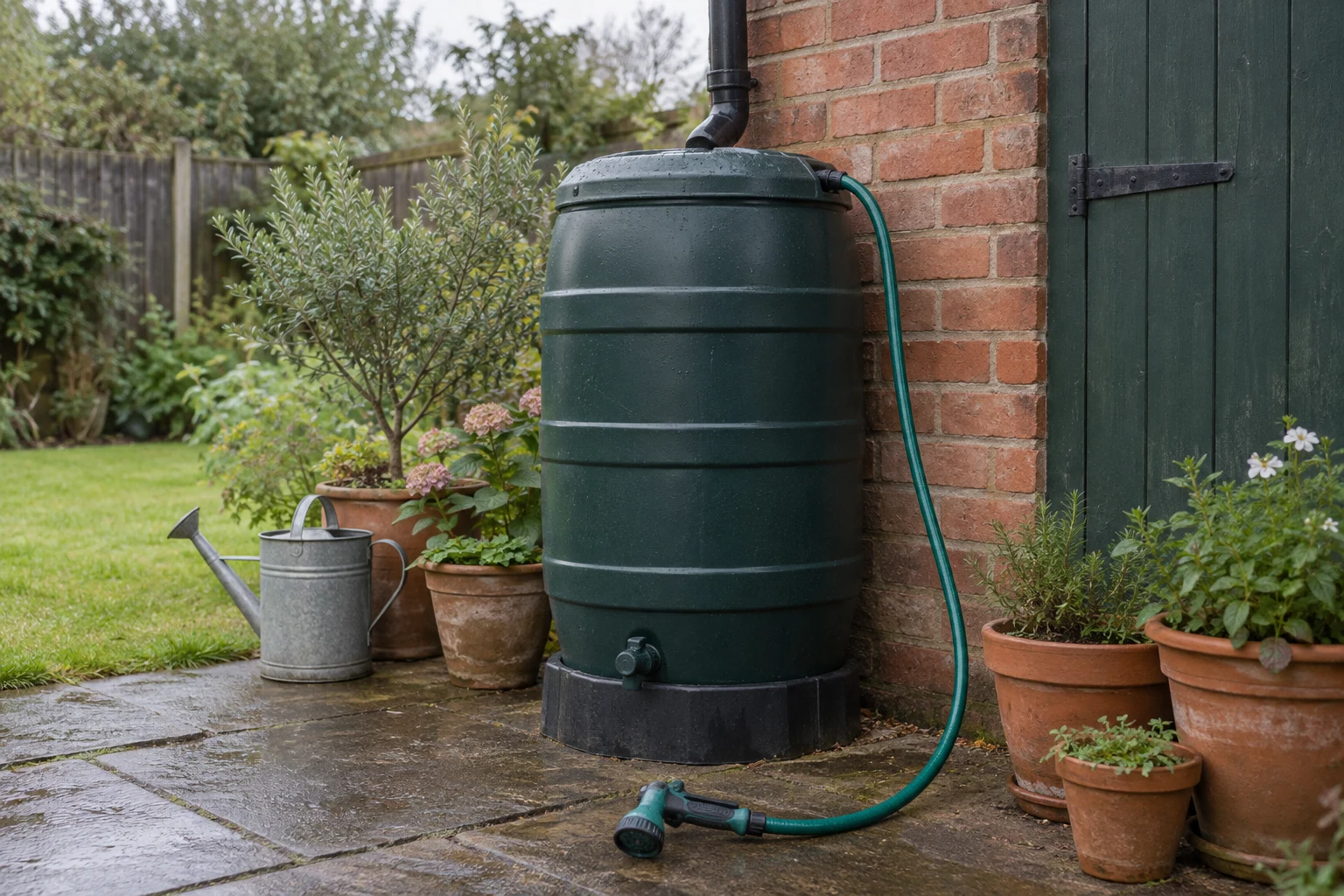
For a hose that you open and close at a spray gun, choose a pump with automatic start and stop in response to water demand. A float switch responds to the water level in the tank; it does not, by itself, stop the motor when you release the trigger. For supervised filling of watering cans, a simpler float-controlled pump may be sufficient.
If the plan is unattended drip irrigation, check the whole pump-and-timer combination before buying. A low-water cut-off, demand control and a watering schedule do three different jobs.
Choose the control for the job
| Your watering task | Control to check |
|---|---|
| Fill cans or use an open hose while present | Manual operation with suitable low-water protection may meet the need. Follow the permitted operating routine. |
| Move between pots with a trigger spray gun | Demand-controlled start/stop, plus low-water protection. |
| Run drippers at set times | A compatible scheduler and pump, including minimum-flow and restart behaviour. |
| Empty the last water from a tank | Check the model’s residual-water and operating limits. Do not defeat protection to gain a few extra litres. |
Read the operating description rather than relying on the word “automatic” in a listing. Ask what starts the motor, what stops it and what happens after the tank runs low.
What a float switch actually controls
A tethered float rises and falls with the water. On a float-controlled pump it must have enough space to move through the manufacturer’s switching positions. A narrow barrel, a hose or the tank wall can obstruct that movement even if the pump body fits through the opening.
The GARDENA 1762/1764/1766 manual distinguishes the float-controlled 4000/1 and 4700/2 inox from the demand-controlled 4700/2 inox automatic. It also warns that bypassing the float for manual operation removes its dry-running protection.
For a supervised, suitable hand-watering route, the GARDENA 4000/1 UK-plug model on Amazon is a float-controlled option to consider. Check the barrel clearance and required outlet pressure first. It is not the demand-controlled automatic model, and its low-water protection is not a reason to leave it running against a closed spray gun.
When demand-controlled start and stop helps
Demand control is useful when you want to walk between containers and operate the hose at the nozzle. The pump must recognise the outlet being opened and closed, rather than depend on you returning to its power switch each time.
As a manufacturer-specified example, the GARDENA 4700/2 inox automatic, article 1766, starts and stops with water demand and has dry-running protection. The non-automatic 4700/2 inox is article 1764.
This is a control comparison, not a claim that either pump will drive your particular sprinkler. Use our water-butt pump buying guide to check pressure, hose reach and usable storage. We have not verified a UK-plug retail variant of article 1766 for this guide, so confirm the exact supplied version and suitable power arrangement with the seller before ordering one.
If you plan to share a battery with another garden tool, check our GARDENA pump battery and charger guide before choosing a pump-only package.
A tap timer does not necessarily switch the pump
A timer fitted in the water line normally controls a valve. Closing that valve is not the same as cutting power to the pump. If you pair it with a pump that continues running while the tank remains full, the timer can close while the motor stays on.
Before combining products, establish whether the pump stops at a closed outlet, restarts when the timer opens, and can supply the timer’s required inlet pressure. Check the permitted closed-outlet period and any special operating mode in the exact pump manual. Do not assume an ordinary timer suitable for a mains tap has the same behaviour on a pumped supply.
A plug-in electrical timer is a different arrangement again. It controls the power supply, so compatibility depends on how the pump restarts after power returns. Use a combination explicitly supported by the equipment instructions rather than adding electrical controls as a workaround.
Small drip systems need a separate flow check
Demand control can behave differently at very small draw-off rates. The article 1766 manual says continuous operation starts at 100 litres/hour; below that it cycles in a low-quantity programme. That programme allows 60 minutes before leakage detection intervenes; longer use requires at least a five-minute interruption before the 60 minutes ends. Check the manual supplied with your version.
As an illustrative calculation, ten nominal 2 litre/hour drippers total 20 litres/hour. That sits below the published 100 litre/hour boundary. It does not prove a fault, or establish how much water your installation actually delivers. It tells you to check the low-flow programme rather than assume the pump will run continuously.
Do not add unnecessary drippers just to keep a pump running: that changes the watering given to the plants. A matched tap-free kit may be a simpler choice for a small group of pots. Our water-butt drip compatibility guide explains the wider options.
Check the full operating cycle before leaving it
Commission the final arrangement while you are present, following its instructions. Observe the start, normal watering, end of demand and permitted restart. Check that the float has room to move, that connections remain dry and that the water supply stays above the specified working level. Keep the tank securely covered with hoses and cables routed as instructed.
For a timed installation, watch a full scheduled cycle and the next restart; a successful initial manual run cannot establish both. Record the starting water level and actual amount used so you know whether storage will last. If a pump already stops unexpectedly or starts with the outlet closed, use our water-butt pump fault checks before buying additional controls.
This guide compares published operating behaviour; it is not a hands-on product test. Sources checked 15 October 2026: GARDENA’s 1762/1764/1766 operating manual (February 2024 edition) and article 1766 product page. Recheck the supplied manual when selecting a different model or version.