
Irrigation · Buying guide
Water-butt pumps: choose pressure and usable storage, not just flow
A pump can save repeated trips with a watering can. But a large litres-per-hour figure does not guarantee a strong spray at the far end of your hose. Match the outlet, the route and the water you actually have before choosing one.
Some links in my articles are affiliate links. I may earn a commission when you buy through them.
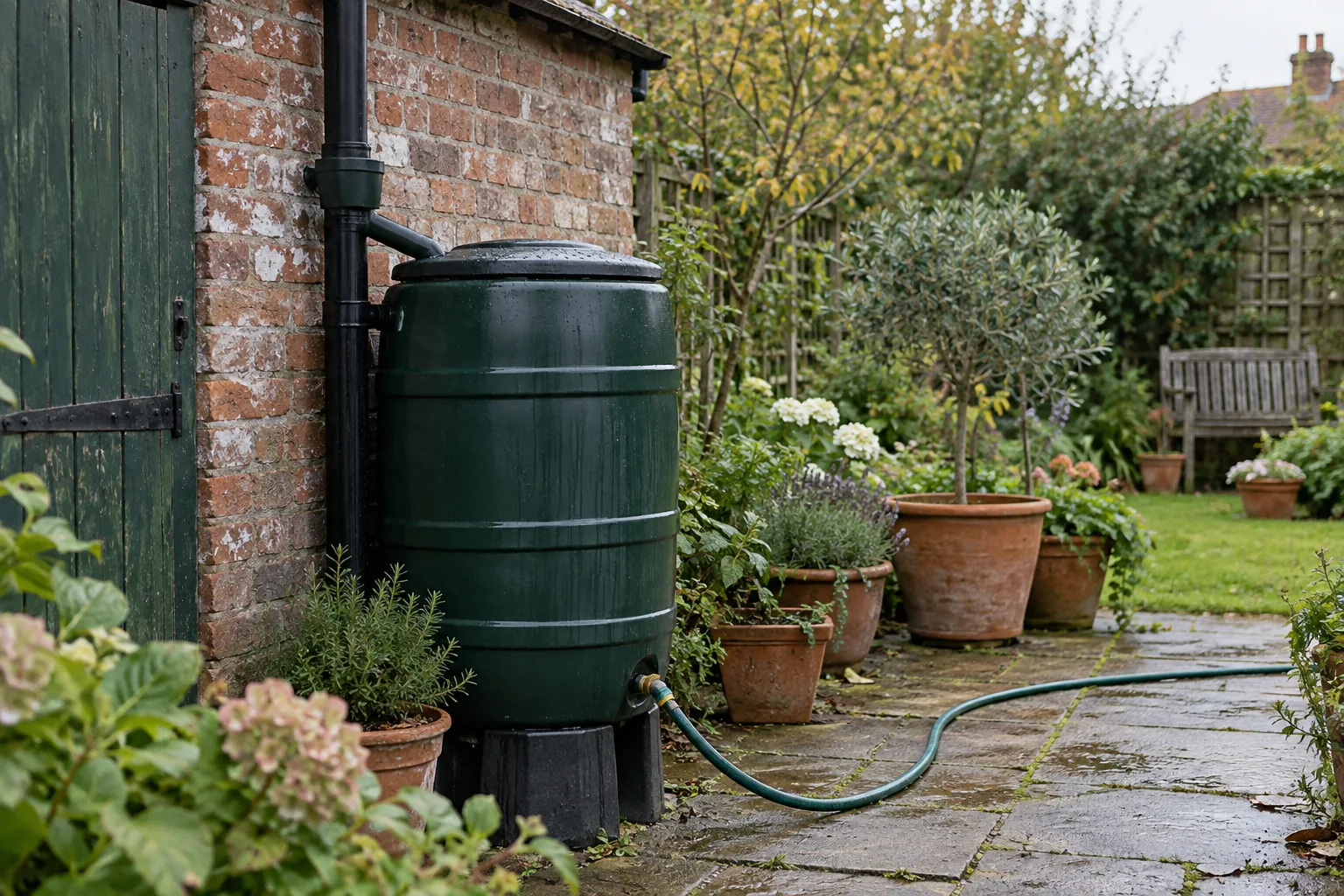
A practical starting point for hand watering
The GARDENA 4000/1, UK model 1762-28, is worth considering for a rainwater butt feeding a hose or filling cans. Its modest maximum pressure makes it a conditional choice for sprinklers, long hose runs or uphill watering: check their requirements first.
Three questions that decide whether a pump will help
- What must the outlet do? Filling a can or running an open hose is different from supplying a sprinkler that needs a stated operating pressure.
- How far uphill is the water going? Measure from the water surface in the butt to the outlet, then note hose length, bore and restrictive fittings.
- How much water is usable? The level above the pump’s minimum operating level matters more than the barrel’s nominal capacity.
For a few nearby pots, filling a can from the butt tap may remain the simplest option. For unattended drip watering, start with our water-butt drip compatibility guide: adding a general-purpose pump does not automatically make a timer and drippers work together.
Maximum flow and maximum pressure are different limits
GARDENA’s UK specifications for the 4000/1 list a 400 W motor, maximum delivery of 4,000 litres/hour, maximum pressure of 1.3 bar and maximum head of 13 metres. Treat those maxima separately. They are not a promise of 4,000 litres/hour delivered through your hose at 1.3 bar.
A pump performance curve relates flow to the pressure or head the pump can provide. Grundfos explains that relationship and why pump selection also needs the system’s characteristics. As resistance and lift increase, the delivered flow changes. A product headline alone cannot tell you the resulting flow at a specific nozzle.
| Specification | Useful interpretation | Do not infer |
|---|---|---|
| 4,000 L/hour maximum delivery | An upper flow limit under favourable conditions | 66.7 L/min at your spray gun |
| 1.3 bar / 13 m maximum | A ceiling on pressure/head | Full pressure after lift and hose losses |
| 400 W motor | Electrical power rating | Compatibility with every sprinkler |
| 7 m maximum submersion | Permitted depth rating for the pump | An extra 7 m of useful uphill reach |
Build a pressure budget before buying
For water, one metre of vertical lift uses about 0.098 bar of pressure. That follows from pressure = density × gravity × height. A nozzle 3 m above the water surface therefore needs about 0.29 bar just for the lift, before allowing for the hose, fittings and pressure needed to make the nozzle work.
Consider an accessory whose instructions require 1 bar at its inlet, positioned 3 m above the butt. Even ignoring friction, it needs about 1.29 bar from the pump. A pump capped at 1.3 bar has essentially no allowance left for useful flow and losses. That is a reason to rule out the combination, not to assume it will just work.
This is a screening calculation, not a prediction of output. For the final choice, ask for the flow available at your required total head. A longer or narrower hose increases losses at a given flow; extra quick connectors and valves also matter. Use the shortest practical route without kinks. Our hose-length measuring guide helps avoid buying unnecessary hose.
A bigger pump does not make the butt last longer
Suppose a 200-litre butt currently offers 160 usable litres after allowing for its actual fill level, sediment clearance and the pump’s cut-off. The table shows what different measured outlet flows would mean. These are examples, not measured 4000/1 results.
| Actual outlet flow | Calculation | Approximate run time |
|---|---|---|
| 5 L/min | 160 ÷ 5 | 32 minutes |
| 8 L/min | 160 ÷ 8 | 20 minutes |
| 12 L/min | 160 ÷ 12 | 13 minutes 20 seconds |
For comparison, applying an illustrative 10 mm over 40 m² takes 400 litres before losses: 1 mm over 1 m² equals 1 litre. A small butt can be useful for containers while being a poor reservoir for a lengthy sprinkler session. More pressure cannot solve a storage shortage. Work out the volume using our water-use calculation guide, then decide whether storage or a pump is the next purchase.
Where the GARDENA 4000/1 fits
The UK 1762-28 listing identifies a UK plug. GARDENA’s manufacturer information on that listing describes a 615–815 mm telescopic pipe, an accessible fine-mesh filter and an adjustable float switch that stops the pump as the water level falls.
Those features address practical jobs: bringing the outlet over the barrel rim, limiting blockage and reducing the risk of running without water. Check the barrel opening, depth and room for the float to move before ordering. A narrow tank can physically accept a pump while still obstructing its control mechanism.
Its limitation is pressure headroom. Choose it for a compatible, relatively undemanding watering route. If you need a particular sprinkler pressure, a substantial rise or several outlets at once, obtain performance data for that duty before committing. Do not substitute a high-flow drainage pump purely because its litres/hour figure is larger; compare pressure and intended use too.
Controls, filters and safe setup deserve their own check
- Float control is not demand control. A low-water cut-off does not by itself mean that closing a spray gun switches the motor off. Confirm the exact model’s operating instructions and permitted closed-outlet behaviour.
- Keep debris out. A pump’s inlet filter protects the pump; it does not establish compatibility with small drippers. Any downstream filter and pressure regulator must suit the irrigation components.
- Check the complete power arrangement. Follow the manufacturer’s electrical and RCD requirements, keep connections protected from water, and disconnect power before handling or cleaning the pump.
- Keep the reservoir secure. Retain a secure lid and route hoses and cables without creating a trip hazard or defeating the cover.
The manufacturer’s product-documentation page provides the operating manuals. Match the manual and plug version to the item supplied. For small emitters, also check our filter and regulator buying guide.
If you prefer a cordless pump, our GARDENA 2400 Solo-versus-set guide compares battery ownership, missing equipment and complete package cost.
Check the system while you are there
After installation, measure delivery at the end of the actual hose using a known-volume container and a timer. Five litres in 45 seconds equals 6.7 L/min. This checks open-outlet flow, not the pressure available with a restrictive nozzle attached. Recheck the watering pattern with the intended accessory, and observe operation as the barrel level falls.
Calculate run time from the usable reservoir volume and the measured flow, then leave margin for the cut-off. Investigate unexpectedly poor output by checking the water level, filter, hose kinks, restrictive connectors and outlet height before assuming the motor is too small.
The buying decision
For nearby hand watering with compatible fittings, compare the GARDENA 4000/1 UK model after checking the barrel and route. For pressure-demanding accessories, choose from a verified operating point rather than maximum flow. If the reservoir runs short on paper, solve the water-volume problem first.