
Twin Tap Connector or Four-Way Distributor? Measure Flow Before Splitting
Some links in my articles are affiliate links. I may earn a commission when you buy through them.
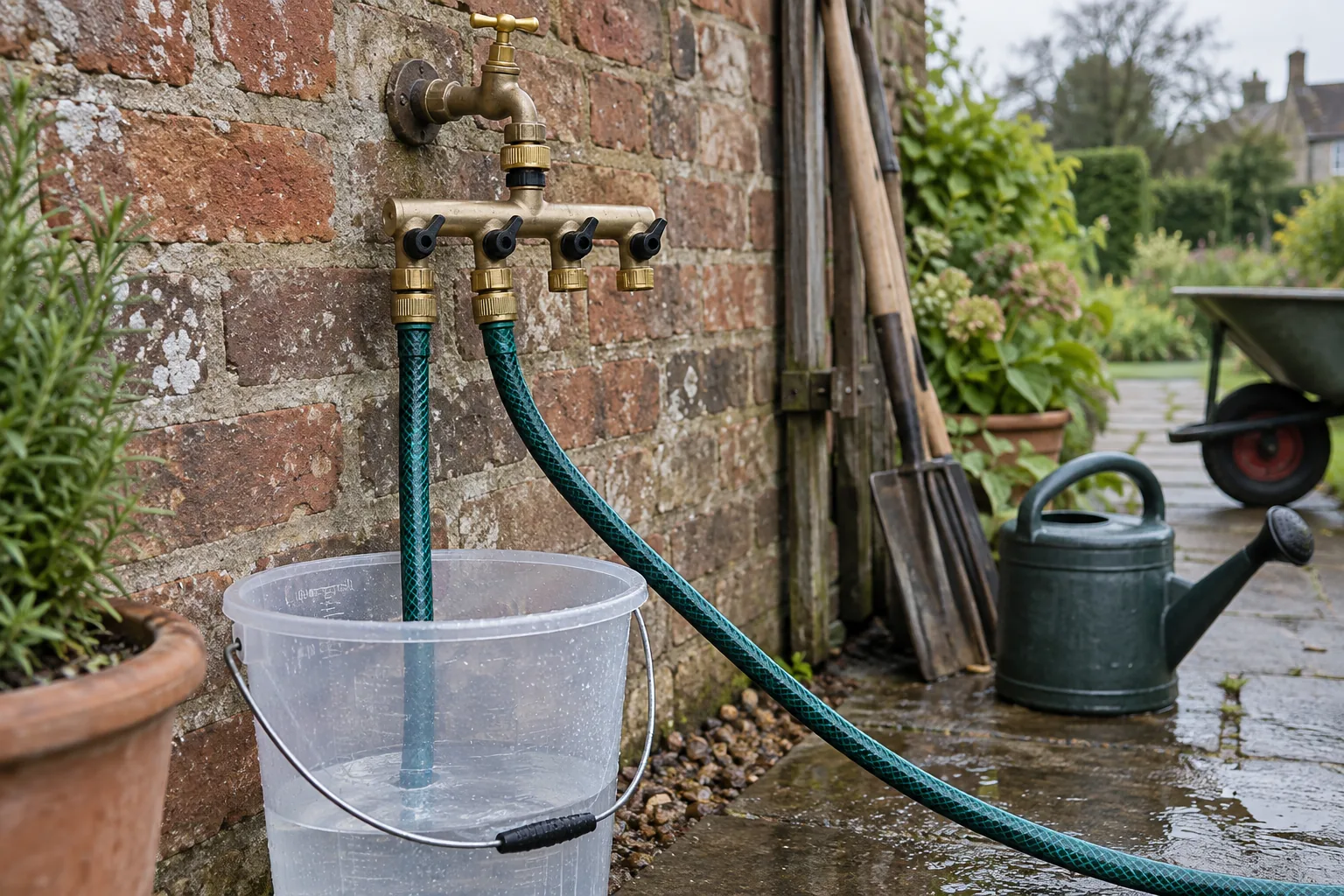
A tap splitter creates more connection points, but it does not create more water. Choose two or four outlets from the jobs that must stay connected, then measure the tap’s usable flow with the intended branches open. If two circuits compete, schedule them in sequence.
Two permanent branches
GARDENA Twin Tap Connector 8193-20: two regulated outlets for a hose plus a second watering device or two planned circuits. Check the twin connector on Amazon UK.
Three or four connections
GARDENA 4 Channel Water Distributor 8194-20: four individually regulated outlets where several hoses or controls need to remain connected. Check the four-way distributor on Amazon UK.
The four-way model is not automatically the stronger choice. It is wider, loads the tap with more fittings and makes it easier to open more demand than the supply can serve. The twin model is often neater when only two branches have a permanent job.
Count connections and simultaneous jobs separately
| Garden plan | Connection count | Likely choice | Operating plan |
|---|---|---|---|
| One hand hose plus one drip line | 2 | Twin connector | Use together only after checking flow; otherwise pause the drip line while hand watering. |
| Front hose, rear hose and one timer | 3 | Four-way distributor | Leave all connected, but normally open one watering branch at a time. |
| Two irrigation zones with separate controls | 2 | Twin connector | Set non-overlapping programmes if flow falls when both open. |
| Four low-demand micro-irrigation zones | 4 | Four-way distributor | Confirm each zone’s inlet requirements and measure the real combination. |
| One hose moved between tasks | 1 | No splitter needed | A quick connector may be simpler and place less weight on the tap. |
First verify the tap thread
GARDENA’s technical data for the Twin Tap Connector 8193-20 lists taps with 21 mm (G 1/2), 23 mm (G 5/8), 26.5 mm (G 3/4) and 33.3 mm (G 1) threads. Its overview specifically highlights the common 26.5 mm and 33.3 mm sizes, so check the included adapters and current package contents for the exact thread you have. The 4 Channel Water Distributor 8194-20 lists 26.5 mm (G 3/4) and 33.3 mm (G 1).
Those measurements describe tap-thread standards, not the bore of the garden hose. Measure the exposed threaded outlet and compare its form with the manufacturer’s diagram. Do not force a plastic adapter over damaged, painted or cross-threaded metal. Our garden-hose connector guide separates tap thread, hose bore and quick-connector size.
| Check | Twin Tap Connector 8193-20 | 4 Channel Distributor 8194-20 |
|---|---|---|
| Maximum connected devices | 2 | 4 |
| Listed tap threads | 21, 23, 26.5 and 33.3 mm (G 1/2, G 5/8, G 3/4 and G 1) | 26.5 and 33.3 mm (G 3/4 and G 1) |
| Outlet regulation | Regulated or switched off individually | Regulated or switched off individually |
| Stated simultaneous use | Two devices | Up to four devices |
| Frost protection | No | No |
Measure total usable flow in sixty seconds
Use a bucket with a known volume and a stopwatch. Open the tap to the position you intend to use, time how long it takes to collect a measured amount, then calculate litres per minute:
Example: 5 litres collected in 20 seconds gives 5 × 60 ÷ 20 = 15 L/min.
Repeat the test through the splitter, hose and any timer or filter that will remain in the system. Then test the actual combinations: branch A alone, branch B alone, and A plus B together. Two branches rarely divide the total perfectly because hose length, bore, height and emitters create different resistance.
Compare the measured results with each connected device’s stated operating requirement. Keep practical headroom rather than designing around the best single test: supply can change as valves move, filters collect debris or another household outlet is used. A four-way body is useful for parking connections even when the safe operating plan is one branch at a time.
A splitter provides control points. It cannot multiply the tap’s available flow or pressure.
When sequential watering is the better design
Suppose a sprinkler performs well alone but loses coverage when a drip circuit opens. Throttling one branch may restore balance, but it can also move the drip system outside its intended conditions. Running the sprinkler first and the drip zone afterwards is usually easier to verify. Use non-overlapping timer programmes and allow a small gap so one valve closes before the next opens.
Do not assume every electronic timer can sit on any outlet orientation or that four timers will physically fit side by side. Check the control’s permitted mounting position, inlet thread, clearance, supported pressure and weather instructions. Heavy controls and tight hoses increase leverage on the outdoor tap; support long hose runs and avoid leaving the manifold as a handle. Our timer compatibility checks and watering-timer comparison cover the next stage.
Installation and first-run checklist
- Photograph and measure the tap outlet. Match the thread and included adapters to the exact product specification.
- List every permanent connection. Count what must remain attached, then separately mark which branches must run together.
- Run the bucket test. Measure at the end of each real route, including the splitter, hose, timer and filter.
- Label branches. A simple weatherproof tag prevents the wrong outlet being opened or a live timer being isolated.
- Check for leaks under pressure. Inspect the tap joint, adapters and each outlet with branches closed and open. Reseat seals rather than overtightening.
- Observe the first full cycle. Confirm each zone starts and stops as planned and that overlapping demand does not reduce sprinkler coverage or drip delivery.
- Drain before frost. Both reference products are listed without frost protection. Follow the instructions and store them dry when freezing conditions are possible.
The buying decision
Choose the Twin Tap Connector when two branches cover the real plan and its adapter arrangement matches the tap. Choose the 4 Channel Water Distributor when three or four devices need permanent connection and the wider body’s listed threads fit. In either case, let measured flow decide which outlets can operate together.