
Irrigation · Buying guide
Sprinklers for narrow lawns: why adjustable width beats maximum area
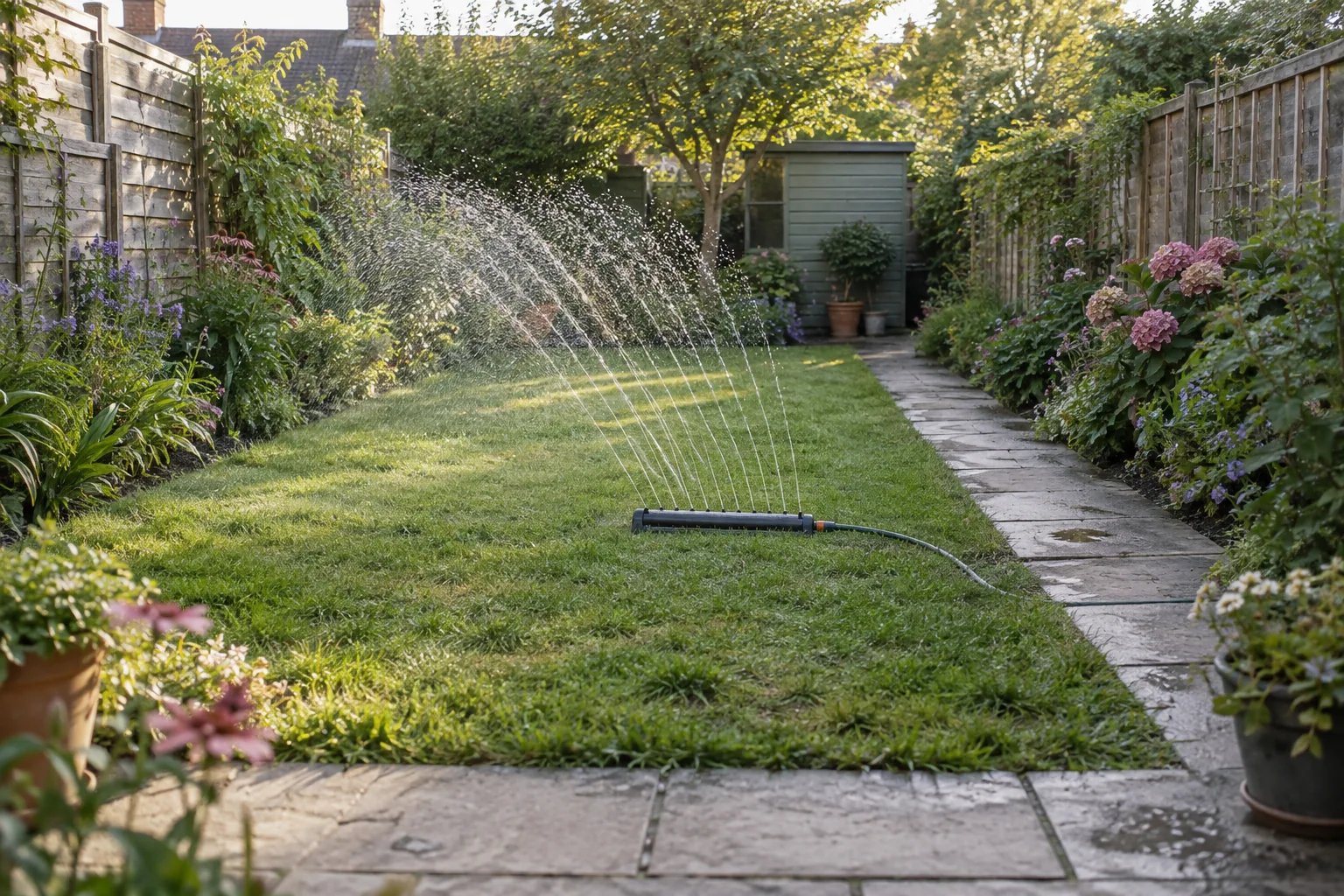
A sprinkler rated for 220 m² can be a worse fit for a narrow lawn than one rated for 150 m². The useful question is whether its wet rectangle matches your grass without soaking the path, fence or patio.
Some links in my articles are affiliate links. I may earn a commission when you buy through them.
For a narrow rectangle
GARDENA AquaZoom S offers separate width adjustment from 3–10 m and range adjustment from 3–15 m. It is the stronger starting point when avoiding overspray matters.
Check AquaZoom S on AmazonFor a broader open lawn
GARDENA Aqua S adjusts its range from 7–17 m, with a stated maximum width of 13 m. Consider it where the available spread fits your lawn.
Check Aqua S on AmazonFirst decide whether the lawn needs watering
For an established lawn turning brown in summer, a sprinkler may be an unnecessary purchase. The RHS advises resisting routine watering of established lawns during drought, because they usually green up again when rain returns. New seed or turf presents a different problem while roots establish.
Buy for that actual job: protecting a new lawn during a dry spell, irrigating a defined area when needed, or replacing a sprinkler that repeatedly misses a strip. Check current local water-use restrictions before running one. Once autumn rain keeps the soil moist, a calendar-based sprinkler routine can add water the lawn does not need.
Measure a rectangle, not just square metres
A 4 m × 12 m lawn and an 8 m × 6 m lawn both cover 48 m². Their sprinkler requirements are different. One needs a narrow, long pattern; the other needs a broader, shorter one. A maximum-area badge conceals that distinction.
Measure the grass at its narrowest and widest points and mark the places you want to keep dry. For an L-shaped lawn, plan two watering positions rather than trying to cover the missing corner. Where the lawn tapers, decide whether occasional hand watering of an awkward edge is preferable to spraying hard surfaces.
overspray
12 m long
48 m²
overspray
An 8 m-wide wet pattern across a 4 m-wide lawn covers twice the target area. This schematic shows geometry, not a measured product spray pattern.
In that idealised 8 m × 12 m example, only half the wetted area is lawn. Actual water distribution will not be perfectly uniform, so this is not a claim that a particular sprinkler wastes exactly 50%. It shows why independent width control can matter more than a bigger coverage rating.
Aqua S versus AquaZoom S: the useful differences
| Decision point | Aqua S | AquaZoom S |
|---|---|---|
| GARDENA UK reference | 18700-20 | 18710-20 |
| Stated area range | 90–220 m² | 9–150 m² |
| Adjustable range | 7–17 m | 3–15 m |
| Width specification | Maximum 13 m; separate width control not specified | Adjustable 3–10 m |
| Best reason to consider it | A wider lawn with room for the spray | Matching a smaller or narrower rectangle |
| Retail link | View Aqua S | View AquaZoom S |
Sources: GARDENA’s Aqua S specification and AquaZoom S specification. These are published adjustment ranges, not guaranteed dimensions at every home’s water supply. The linked AquaZoom S retailer listing uses model suffix 18710-34 and the same EAN 4078500048071 shown on GARDENA’s UK page; check the supplied pack and model before ordering.
For the example 4 m × 12 m lawn, AquaZoom S is the more sensible shortlist: both dimensions fall within its published adjustment ranges. Aqua S starts at a published area of 90 m² and offers less control over the width. That does not prove it cannot put water on 48 m²; it means it is a less convincing purchase when containment is the priority.
For a strip less than 3 m wide, neither headline specification establishes a good match. Look for a model with a verified narrower pattern, or consider a different watering method. Do not buy AquaZoom S expecting its 3 m published minimum width to become an assured 1 m strip.
Why turning down the tap is not a complete substitute
Reducing the supply can shrink a spray pattern, but it changes more than its width: the throw, flow and oscillation may also change. You can lose reach at the ends while still wetting an unwanted edge. Separate width and range controls let you shape the rectangle more deliberately.
Check performance with the hose, connectors and timer you intend to use. Remove kinks and unnecessary hose length. A sprinkler connected near the tap may behave differently at the end of a long hose, particularly when another outlet is running. If the pattern becomes erratic, diagnose the supply before upgrading the sprinkler. Our hose-route guide and watering timer comparison cover those parts of the setup.
Measure watering depth instead of guessing minutes
Put several identical, straight-sided containers across the intended footprint, including the edges and corners. Run the sprinkler under calm conditions for a measured period, then compare the depths collected. Large differences reveal a placement, wind or supply problem that a longer run alone may not fix.
Suppose four containers collect 2, 3, 3 and 4 mm in 15 minutes. Their mean is 3 mm, equivalent to 12 mm/hour at those sample points. If you had a reason to apply 6 mm, the mean suggests 30 minutes at the same settings. But the driest sample would receive only about 4 mm in that time, while the wettest would receive about 8 mm. Improve distribution before simply extending the timer.
| Example | Calculation | Result |
|---|---|---|
| Target area | 4 m × 12 m | 48 m² |
| Illustrative applied depth | 48 m² × 6 mm | 288 litres on the lawn |
| Measured mean rate | 3 mm ÷ 15 min × 60 | 12 mm/hour |
| Time for that mean depth | 6 ÷ 12 × 60 | 30 minutes |
Six millimetres is an arithmetic example, not a universal watering prescription. Adjust to the soil, recent rain and stage of establishment. If puddles or runoff form, stop and let water soak in before deciding whether more is needed. Keep conditions comparable when measuring, and recheck after changing position or settings. The same measure-before-adjusting approach appears in our dripper output guide.
Choose the control you actually need
Shortlist AquaZoom S if your main problem is a narrow rectangular footprint within its stated ranges. Consider Aqua S for a broader lawn where its spread fits and extra width adjustment adds little value. In either case, verify the footprint with your own supply before leaving a timer to repeat it.
If the actual job is watering pots along the path or an adjoining planted border, target those separately rather than widening the sprinkler to reach everything. See our container irrigation guide for a more controlled approach.