
Tap-free watering · Buying guide
GARDENA AquaBloom vs AquaBloom L: Which Kit Fits Your Pots?
Some links in my articles are affiliate links. I may earn a commission when you buy through them.
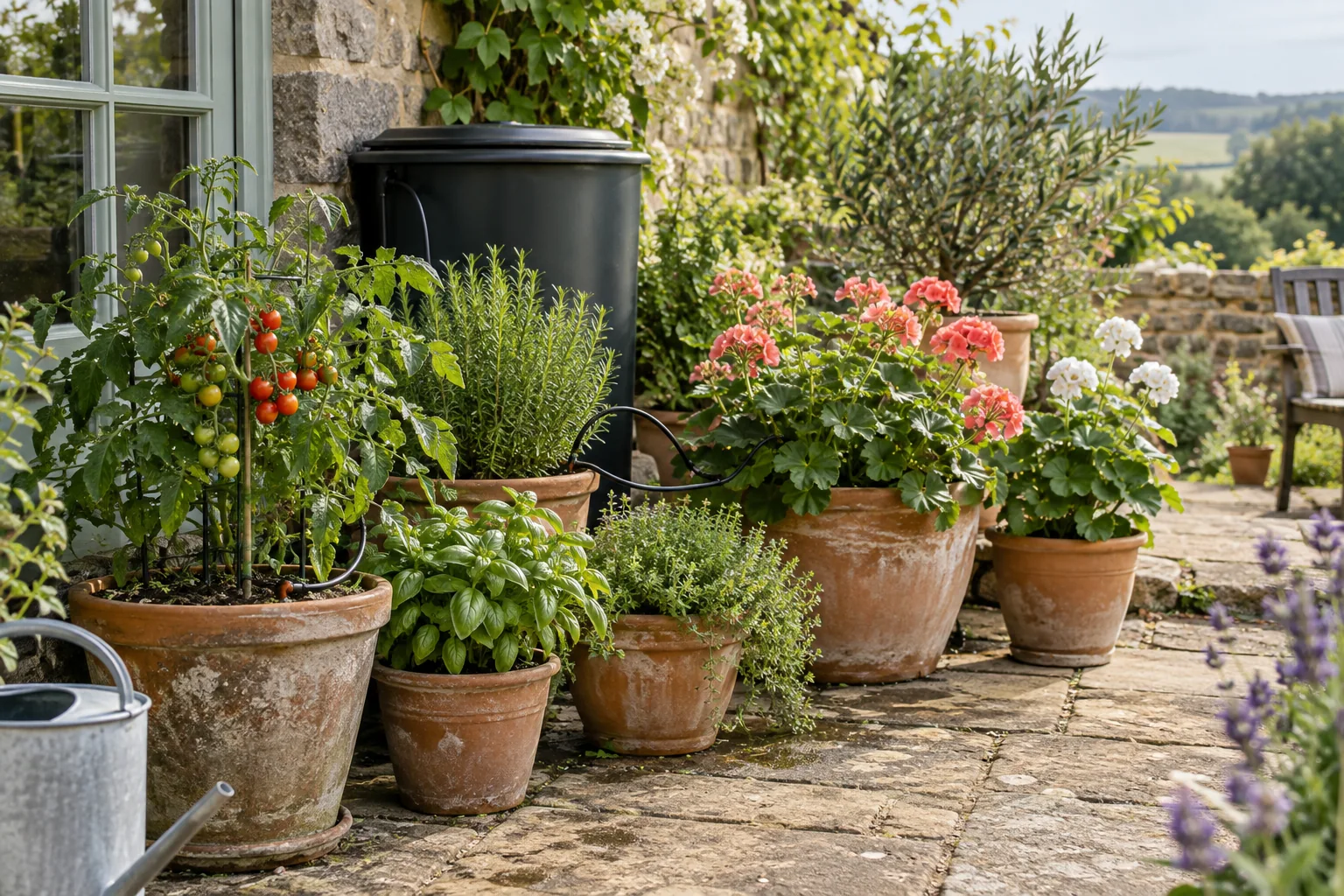
Choose AquaBloom for a modest group of pots with similar needs; consider AquaBloom L when you need a mix of lower- and higher-output drippers. But size the reservoir before choosing either. The L kit supplies 50% more outlets, yet its complete dripper mix has 4.5 times the nominal hourly demand.
For a smaller pot collection
AquaBloom 13300-20 supplies twenty 0.5 L/h drippers. Bring your own water container.
View AquaBloom 13300-20 on AmazonFor mixed watering needs
AquaBloom L 13330-20 supplies twenty 2 L/h and ten 0.5 L/h drippers. Plan more storage where you use the higher-output heads.
View AquaBloom L 13330-20 on AmazonCompare the exact kit, not just the AquaBloom name
These are solar-powered pump systems for watering without a nearby tap or mains socket. A reservoir is still essential. The standard set and its reservoir bundle use the same nominal dripper rate; the L set changes the supplied emitter mix. Check the article number in the seller’s selected option before ordering.
| Specification | AquaBloom 13300-20 | Reservoir set 13301-20 | AquaBloom L 13330-20 |
|---|---|---|---|
| Supplied drippers | 20 × 0.5 L/h | 20 × 0.5 L/h | 20 × 2 L/h; 10 × 0.5 L/h |
| Supplied tube | 20 m, 4.6 mm | 20 m, 4.6 mm | 20 m, 4.6 mm |
| Water container | Supply separately | 10.5 litres included | Supply separately |
| Planning advantage | Simple, uniform outlet rate | A compact matched reservoir | Two outlet rates for different demands |
| Main constraint | Storage and plant demand still need calculating | 10.5 litres may be too little for a long absence | More outlets share the same supplied tube length |
The figures above come from GARDENA’s model specifications, linked below. They describe the supplied parts, not a promise that every plant will receive enough water on every preset.
The reservoir calculation that changes the decision
“Up to 20 plants” is a connection count. It cannot tell you how many days a tank lasts. Add the nominal rates of the outlets you will actually install, multiply by runtime in hours, then by the number of daily runs and days away.
For a hypothetical 15-minute run once daily for seven days, twelve standard 0.5 L/h outlets use 10.5 litres. All twenty use 17.5 litres. On the L kit, six 2 L/h outlets plus six 0.5 L/h outlets use 26.25 litres. These are calculations from nominal rates, not a suggested watering programme; choose the available preset and duration to suit the plants.
| Example installed outlets | Total rate | Seven-day demand | With an illustrative 25% allowance, rounded up |
|---|---|---|---|
| 12 × 0.5 L/h | 6 L/h | 10.5 L | 14 L |
| 20 × 0.5 L/h | 10 L/h | 17.5 L | 22 L |
| 6 × 2 plus 6 × 0.5 L/h | 15 L/h | 26.25 L | 33 L |
The 25% allowance is a planning example, not a manufacturer requirement or a guarantee. Usable water can be less than the container’s capacity because of the intake position; demand can change in hot or windy weather. Keep the reservoir covered, stable and accessible for refilling, and follow the intake-position instructions.
Using every supplied outlet makes the difference starker: standard AquaBloom totals 10 L/h; the L mix totals 45 L/h. At the same quarter-hour daily runtime, the latter would need 78.75 litres for a week before any allowance. More capacity at the pump does not create more water in the tank.
When the smaller AquaBloom makes sense
A few similar-sized pots grouped near a reservoir are the clearest fit. A uniform outlet rate is easier to plan when plants have broadly similar requirements. The 13300-20 set lets you choose a water container around the storage calculation, while the 13301-20 bundle adds a compact 10.5-litre container.
Do not interpret the reservoir bundle’s advertised “up to” duration as your refill interval. In the twelve-outlet example above, its entire nominal capacity is already allocated to seven days, with no allowance. A compact bundle can be convenient for regular refilling yet unsuitable for the same pots during a longer holiday.
When AquaBloom L earns its place
The L set’s two supplied outlet rates give you a practical way to allocate different nominal volumes during one shared runtime. One 2 L/h outlet supplies four times the nominal volume of one 0.5 L/h outlet. That is useful when the collection is not uniform, but it does not replace checking moisture in each pot.
The RHS container-care guidance highlights the greater demands of leafy crops such as tomatoes compared with plants such as lavender. Avoid treating a thirsty vegetable and a drought-tolerant herb as identical just because their pots sit beside each other. For a mixed group, start with the AquaBloom L listing, then draw the outlet allocation before buying.
Neither “30 plants” nor a larger model means unlimited expansion. All three listed kits supply 20 metres of tube. Measure the route around furniture and between pots, including vertical runs. Do not assume the standard pump can be converted into an L system by fitting higher-output drippers; confirm any change against the exact model’s instructions.
Three checks before you commit
- 1 · WaterCalculate storage from the intended outlets and watering schedule.
- 2 · RouteMeasure the actual tube route, including rises and detours.
- 3 · LightFind a suitable sunny position for the solar unit within the installation limits.
A shaded balcony, scattered pots or insufficient safe space for water storage can rule out a kit before its plant count matters. Check the model’s permitted height differences and layout in its instructions; do not assume a solar pump can lift water to any shelf. If you already have a tap, compare a tap timer and suitable drip layout too. A water-butt setup has its own pressure constraints, covered in our water-butt irrigation guide.
For a solar alternative with a manually selected rain delay, compare the Solar Select buying and layout guide, including its minimum outlet count and branch limits.
Make the first week a commissioning period
Run the completed layout while you are home. Check all outlets and use our catch-test method to compare delivered volumes. Separately check whether water reaches the compost where roots need it: equal outlet flow does not mean equal moisture in different pots.
The RHS recommends checking containers regularly, with daily checks often needed from spring to autumn. Adjust to conditions rather than leaving a summer setting unchanged into cooler weather. Inspect connections, the intake filter and remaining water before an absence; our holiday watering checklist covers the final checks.
Which would suit your layout?
Choose AquaBloom 13300-20 when a uniform group of pots and a separately sized reservoir solve the problem. Choose AquaBloom L 13330-20 when different outlet rates are useful and you can support their water demand. If storage or sunlight is the limiting factor, changing the kit size alone will not solve it.