
Search
Indoor watering · Buying guide
Best Indoor Holiday Watering Systems: Choose for Your Pots and Power Supply
By James Thompson
Some links in my articles are affiliate links. I may earn a commission when you buy through them.
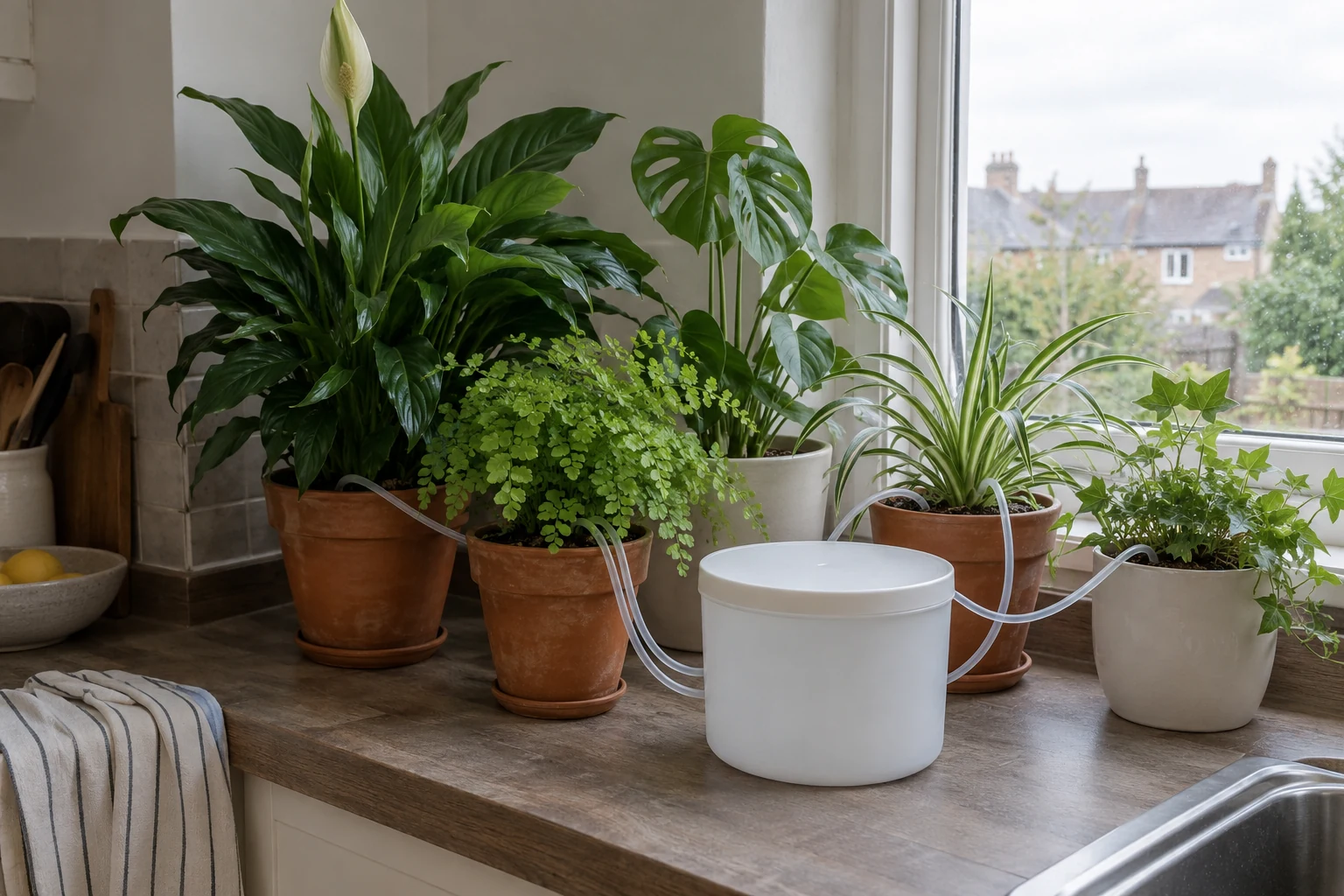
For a few houseplants in their existing pots, a ceramic-cone system is worth considering when you can trial its reservoir position before leaving. Capillary matting suits a group of small pots that can make good contact with a shared wet surface. A pumped kit suits a larger collection with different measured daily doses, provided you have a suitable power supply and room for a safe reservoir layout.
There is no single best system for every plant. A cactus that needs a dry interval and a thirsty leafy plant should not automatically share the same watering method. Start with what each plant needs during your actual absence; a short trip may need no new equipment.
Table of Contents
ToggleChoose by the problem you need to solve
| Your situation | First option to assess | Main limitation |
|---|---|---|
| A few separate pots; no electricity wanted | Ceramic cones supplied from a nearby container | Priming and reservoir height affect delivery; each pot needs a trial. |
| Small pots that can sit together | Capillary matting on a waterproof support | Water must reach the compost through the pot base; decorative outer pots interrupt the route. |
| Many pots with different daily requirements | A pump with separate dose outlets, such as GARDENA 1265-20 | Fixed daily dosing, a suitable mains arrangement and a reservoir below the pots. |
| A permanent watering arrangement | An established self-watering planter | Conversion and root establishment take time; systems differ between planter ranges. |
| A short absence, especially with slow winter growth | Normal watering and a cooler suitable position; a helper if needed | Check the species, room temperature and how quickly that pot actually dries. |
The comparison is based on manufacturer instructions and RHS guidance, not hands-on comparative testing. Pack sizes and headline plant counts tell you less than whether the system fits your pots and room.
For a few existing pots: Blumat Classic
Blumat Classic feeds a ceramic cone from an external water container through a thin tube. It avoids repotting and does not need a tap or electricity. That makes it a practical candidate for separate houseplants whose pots can remain near a reservoir.
The setup is its important constraint. Blumat specifies a full, sealed cone and a water level slightly below its cap for the intended moisture-responsive behaviour. Raising the water above the cap changes delivery and can keep supplying water even when the compost is wet. An attractive jug on a high shelf is therefore not automatically a suitable reservoir.
Check the exact product name: Classic is different from Tropf-Blumat, the dripper system used in other irrigation installations. Do not buy a Tropf accessory expecting it to replace a complete Classic cone and tube.
Blumat Classic three-pack on Amazon UK is a route for the small Classic set. Check the selected pack quantity before ordering. Choose it when you have time to establish delivery in each pot; do not treat a packet’s nominal output as proof it will sustain your largest plant.
For a group of small pots: capillary matting
A mat provides a shared damp surface beneath compatible pots. It can be a simpler purchase than a pump when several small plants already sit together. The useful buying checks are the area you need to cover, the product’s reservoir-feed instructions and whether you can protect the surface underneath.
The RHS highlights contact between the compost and mat as essential. A pot standing inside a sealed cachepot cannot draw through that outer base; material blocking the drainage hole can also break the connection. Check your actual pots before measuring out a large sheet.
Compare capillary matting for houseplants on Amazon UK. This is a product-type search, not a recommendation that every result suits indoor use. Compare dimensions, feed arrangement and care instructions; terrarium liners and unrelated absorbent sheets may appear among results.
Trial the complete arrangement rather than merely checking that the mat feels wet. A wet mat beside a drying root ball has not solved the watering problem. Keep plants that dislike sustained moisture outside the group.
For a larger collection: a pumped holiday kit
The GARDENA 1265-20 holiday kit uses three distributors with different daily doses and up to twelve outlets on each. This gives more scope to group pots by demand than one shared wet mat. It is a fixed daily watering arrangement, so the trial must establish which outlet allocation suits each plant.
Count watering lines, not just plants. A plant needing more than one outlet uses more of the kit’s capacity. You also need a suitably sized water container, room to route tubes securely and an appropriate power supply. This is separate from GARDENA AquaBloom solar kits; their controls and setup instructions are not interchangeable.
UK power check before buying: the GARDENA 1265-20 listing on Amazon UK identifies model 1265-20, but we have not verified the supplied UK plug format. Ask the seller to confirm a complete suitable UK power arrangement for the exact supplied kit. Do not assume that an Amazon UK listing guarantees a UK plug, or improvise a conversion.
Choose a pumped kit when those practical requirements are resolved and your plants suit its daily pattern. Choose a passive method or a helper when suitable power or a safe low reservoir position is unavailable.
For long-term convenience: reservoir planters
A self-watering planter can be worthwhile when you want fewer routine watering visits throughout the year. It also changes the container system, so compare the total cost of replacing pots rather than the price of one watering accessory.
Do not assume every planter uses the same mechanism. LECHUZA distinguishes wick systems that retain a small nursery pot from classic systems involving repotting and a growing-in period. Check the instructions for the exact planter, including how to read its water indicator and when the roots can use the reservoir.
A newly repotted plant is a poor last-minute holiday experiment. Establish the planter during ordinary care, observe its refill cycle and only then rely on it while away. A reservoir indicator shows water in the container; it does not by itself prove that a newly placed root ball can reach it.
Work out whether you need a system at all
The RHS holiday-care guide recommends considering the length of the absence and moving suitable plants to a cooler position away from bright windows. In winter, some houseplants may manage a week or two without attention, but that is not a promise for every species or heated room.
Look at your normal watering record. If a particular pot usually remains suitably moist for longer than the trip, installing continuous watering may add an unnecessary risk. If it dries quickly, decide whether moving it to a suitable cooler location reduces the problem enough, or whether it needs an established watering method.
For a long absence, or plants with very different care needs, a reliable helper can be the better investment. Leave plant-specific instructions and show the setup in person before travelling. A helper can respond to a fallen tube or unexpected room conditions in a way a fixed timer cannot.
Check the whole arrangement before departure
- Group by care needs. Separate plants needing dry intervals from those that tolerate steady moisture. Keep light and temperature suitable when moving them.
- Trial in the final positions. Include the actual pot, reservoir, tube route and power arrangement. Watch both compost moisture and drainage, not just falling reservoir water.
- Measure usable water. Water below the pickup level is not available to the system. Leave additional capacity for variation rather than filling a container to an unstable brim.
- Protect the room. Use waterproof trays or another suitable protected location, secure tubes and keep the reservoir stable. A saucer that holds one normal watering may not contain a prolonged leak.
- Arrange a fallback. Leave enough access for a helper to inspect the plants, refill safely and spot faults. Avoid making the first unattended run your holiday.
Use our holiday watering checklist for the wider departure plan. For a metered system, the water-use calculation guide explains how to turn delivery into a reservoir requirement.
Sources and buying checks
Manufacturer instructions and UK listing identities checked on 14 October 2026. No prices, promised absence durations or independent reliability rankings are stated. Stock and supplied variants can change.