
Which Garden Hose Connector Fits? Measure the Bore, Then Choose the End
Some links in my articles are affiliate links. I may earn a commission when you buy through them.
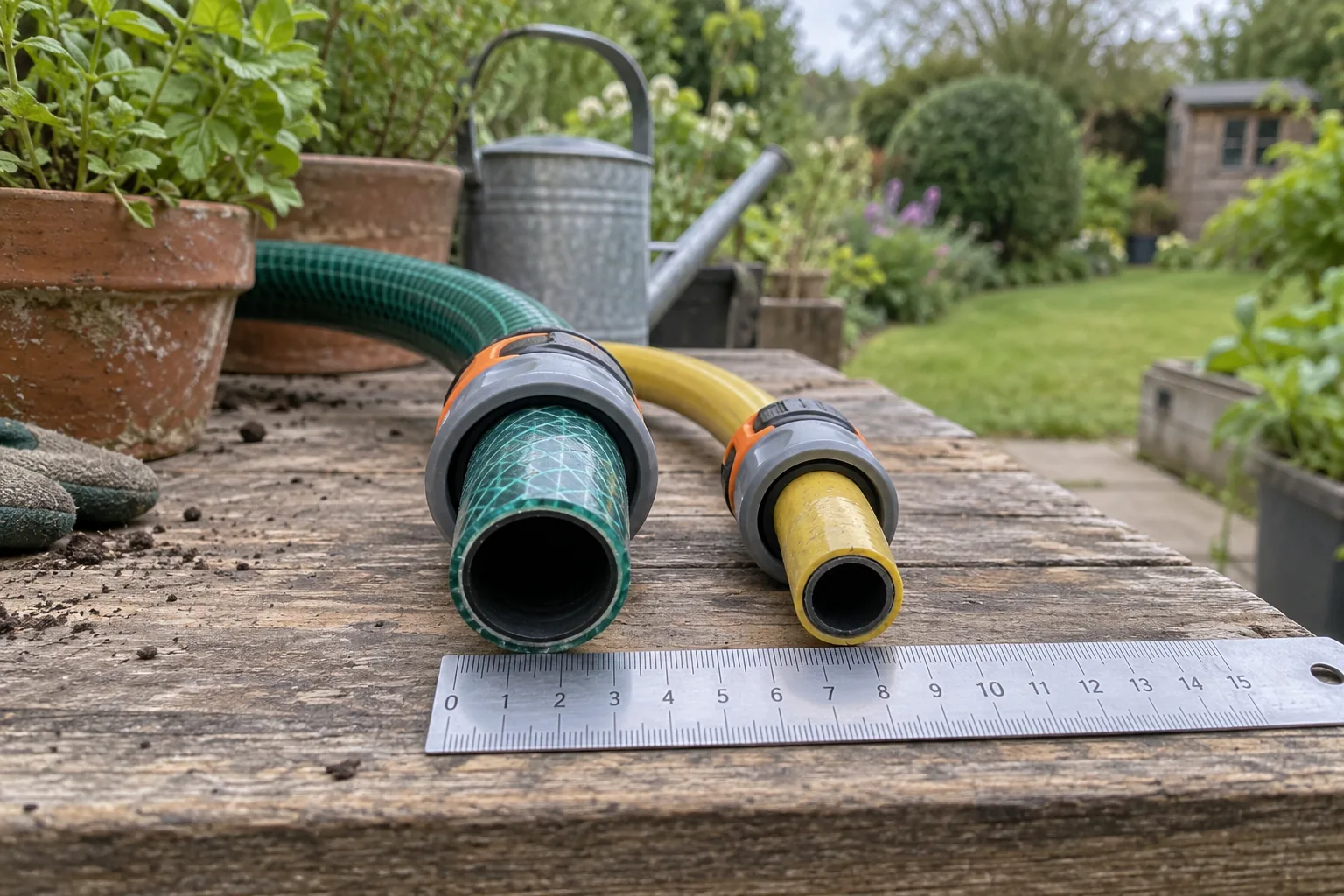
Hose fittings can look interchangeable on a shelf while gripping different hose sizes and doing different jobs. The fastest way to buy the right part is to separate three questions: what is the hose’s inner diameter, where is the fitting going, and do you want water to stop when an accessory is removed?
13–15 mm hose
GARDENA’s 18215-20 is a standard connector for the hose lead. Check this 13–15 mm connector. At the accessory end, 18213-20 adds an automatic water stop: check the water-stop version.
19 mm hose
GARDENA lists 18216-20 for 19 mm hose at the hose lead. Check the 19 mm connector. It is a size choice, not a way to enlarge a 13 mm hose.
Those are verified model examples, not proof that every quick-connect brand, hose construction or tap outlet mates perfectly. Match the exact hose and fitting details on the current listing before buying.
Do not confuse hose bore with tap thread
The 13, 15 and 19 mm figures on these GARDENA hose connectors describe hose size. They are not the thread diameter on an outdoor tap. A tap connector is a separate part at the supply; the hose connector clamps to a cut hose end; a spray gun or lance clicks into the far end. Our hose-reel route guide helps decide hose length before selecting its ends.
If the hose is unlabelled, make a clean, square cut at a sound section and measure the inside opening without squashing it. A wall-thickness example shows the error: if an old hose measures 23 mm across outside and has a 4 mm wall on each side, its estimated bore is 23 − 2 × 4 = 15 mm, not 23 mm. That calculation is only a measuring aid; check the hose’s stated nominal size, especially if the end is stretched or reinforced.
| What you have / need | Matching example | What it does not solve |
|---|---|---|
| 13 or 15 mm hose at the tap-side hose lead | GARDENA 18215-20 standard hose connector | It does not replace the correctly threaded tap adapter. |
| 13 or 15 mm hose at a removable spray accessory | GARDENA 18213-20 Water Stop | The valve acts when the accessory is detached; it is not a substitute for turning off the tap for storage. |
| 19 mm hose at its lead | GARDENA 18216-20 standard hose connector | It will not clamp a smaller hose merely because the click profile looks similar. |
| Split or punctured hose mid-run | Use a size-matched hose repairer, not an end connector | Cut back damaged material first; a repairer cannot restore rotten or perished hose wall. |
GARDENA identifies 18215-20 for 13–15 mm and 18216-20 for 19 mm as hose-lead fittings. Its 18213-20 Water Stop page places the valve at the end of the hose and says it closes when the accessory comes off, reopening when a new one clicks in.
Where the water-stop valve belongs
Put a standard connector at the supply end and a correctly sized water stop at the removable accessory end if you frequently switch between a spray gun, lance and sprinkler. The stop makes those changes less messy while the tap remains on. If a nozzle is meant to stay attached, a standard end fitting may be sufficient; the extra valve is a convenience, not a performance upgrade.
Leak diagnosis before buying a replacement
- Water at the tap: inspect the tap adapter, its thread and sealing washer. A different hose-end connector may not address it.
- Water between hose and clamp nut: check the hose size, make a square cut into sound material and refit the nut fully. A hardened or oval end may never seal reliably.
- Water at the click joint: check the mating profile, visible seal and full engagement. Do not assume different ranges are compatible merely because they nearly click.
- Flow falls when attached: a kink, blocked nozzle or undersized system may be responsible; replacing the connector with a larger-bore model cannot increase the bore of the hose itself.
For irrigation micro-tubing rather than a garden hose, sizes and connection methods differ. See our irrigation pipe-size guide instead of buying a hose quick-connect by mistake.
The buying decision
Measure the hose’s inner opening first. For 13–15 mm, the standard lead connector plus an accessory-end water stop is a coherent pair when you swap tools often. For a 19 mm hose lead, choose the 19 mm size and check any separate accessory-end fitting against that bore. If the existing hose wall is perished, replacing the hose may be more dependable than repeatedly replacing connectors.